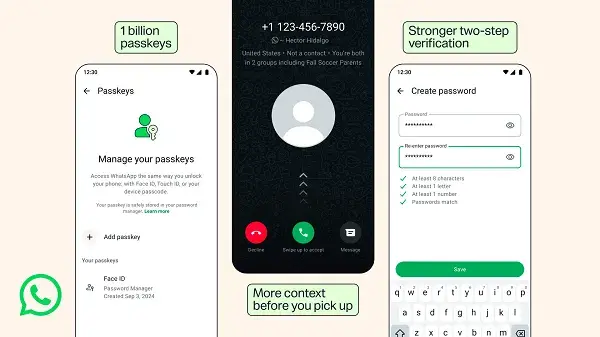
WhatsApp is upgrading several account security options at once. Passkeys — created by more than a billion users since the 2023 launch — can now be registered multiple per account on both Android and iOS. Two-step verification graduates from a six-digit PIN to a full password: longer, alphanumeric, special characters included. As WhatsApp put it, "If you've been using '123456,' this is your sign to upgrade." And on Android, calls from non-contacts now show context before you answer — whether the number is from a different country, and whether you share any groups — to help screen scam calls.
What's changing
Multiple passkeys
Passkeys replace passwords with device biometrics for account access and backups. Allowing several per account reduces the lockout risk when a device is changed or lost.
Two-step verification becomes a real password
A six-digit PIN offers only a million combinations. An alphanumeric password with special characters expands that space enormously, adding a meaningful layer even if a one-time passcode is intercepted.
Caller context
Country-of-origin and shared-group information on unknown callers — a direct response to the volume of international scam calls moving through the app.
Why marketers should care
WhatsApp is a minor channel in some markets, but across Southeast Asia, Latin America, Europe, and the Middle East it's the default messenger and a commerce channel in its own right. For brands running customer service, order notifications, and repeat-purchase flows through the WhatsApp Business API, the app's security reputation is the floor their channel trust stands on. In markets where account takeovers and scams are common, consumers doubt brand messages by default — and platform-level security improvements lower that baseline suspicion at no cost to the brand.
The same logic applies to brands expanding globally: as customer touchpoints move into messaging, trust communications — authenticity checks, order confirmations — have to work on top of the messenger. It's the same structure as authenticity trust becoming a marketing asset in global commerce, which we covered in K-Beauty's Real Export Isn't Product — It's a Discovery System, Built on 2.4 Billion TikTok Views.
Our take: platform trust is a marketing environment variable
Meta's push to foreground safety features reflects a reality where platform trust itself has become a business risk — the dynamic that reached the courtroom in Meta's Trial Comes Down to Two Claims — Is Addiction a Condition, and Did Meta Know?. The practical checklist for marketers is short: if WhatsApp is one of your CS or commerce channels, upgrade the business account's two-step verification to the new password scheme and register multiple passkeys against staff turnover and device loss. When a channel's trust rises, that's usually also the moment to raise your investment in it.