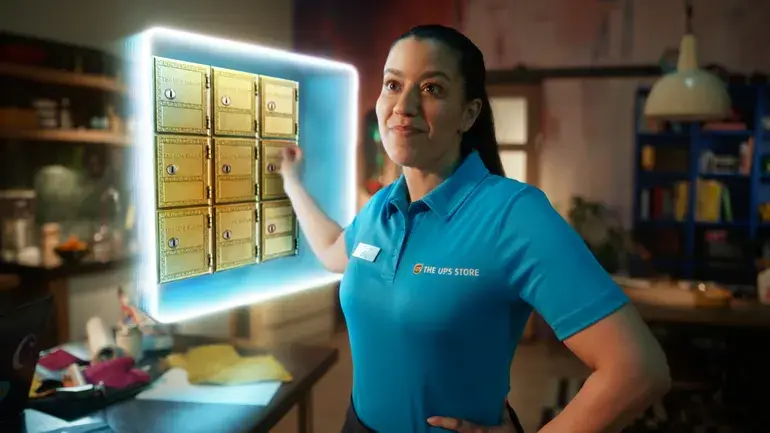
The UPS Store introduced Blu, its first brand character — a friendly woman wearing a blue UPS polo and black pants — as part of a national, multiyear campaign running on television, digital, social and print. The effort targets small business owners and spotlights services such as printing, shipping and mailboxes. It's brand character marketing applied to a franchise problem.
Scattered Franchisees, Scattered Messaging
The character is part of an effort to support locations that are largely owned and operated by independent franchisees. Blu helps unify brand messaging around promoting services beyond shipping.
That's the practically important part. In a franchise structure, every location promotes in its own way, which blurs what the brand actually sells. A recurring character means that even when store-level creative differs, it still reads as one brand.
Paired With an NFL Player
Paramount Media Labs is behind new spots pairing Blu with NFL player and small business owner Aidan Hutchinson. The ads run on Paramount streaming and CBS, with additional content on digital and social channels through early November.
Campaign spots show Blu appearing through a portal to help owners with various tasks. In one 30-second commercial, the character assists a plumber with printing and shredding. In another, the owner of a custom sneaker brand needs a business mailbox.
Characters Are Having a Moment Again
Characters have seen a surge in popularity for marketers, especially for brands looking to stand out in competitive industries or advertise somewhat mundane services, such as insurance, with a bit of comedy and liveliness.
In August, tool company Stanley introduced a sentient, wisecracking toolbox named Stan in its "All Build. No Bull" campaign. Liberty Mutual unveiled a fuzzy yellow puppet named Liberty Biberty in July.
It Tracks a Business Pivot
The effort follows a pivot by United Parcel Service, the parent company, toward premium services. In early 2025 it announced it was reducing deliveries for Amazon by over 50%. The volume reduction led to a broad restructuring, including elimination of 48,000 jobs that year with an additional 30,000 planned for 2026, spurred by the low margins on Amazon deliveries.
CEO Carol Tomé said on a Q2 earnings call that the company is focused on "capturing premium volume" from customers such as small and medium business, health care and B2B. UPS posted consolidated revenues of $22.8 billion in Q2.
So the character isn't just an advertising device — it's a communication vehicle for a business pivot. Moving from volume-driven delivery toward services for small business requires consumers to re-perceive The UPS Store as a place that solves business needs rather than a place to drop off packages. A character pushes that re-perception through repetition.
The Takeaway
Brand characters work particularly well on two problems: unifying messaging when many parties communicate independently, and making a mundane service memorable. The UPS Store has both.
But a character doesn't replace service explanation, which is why each spot in this campaign handles one concrete service — printing, shredding, mailboxes. The character carries memory; the individual ads carry information.