The most revealing query is the next one
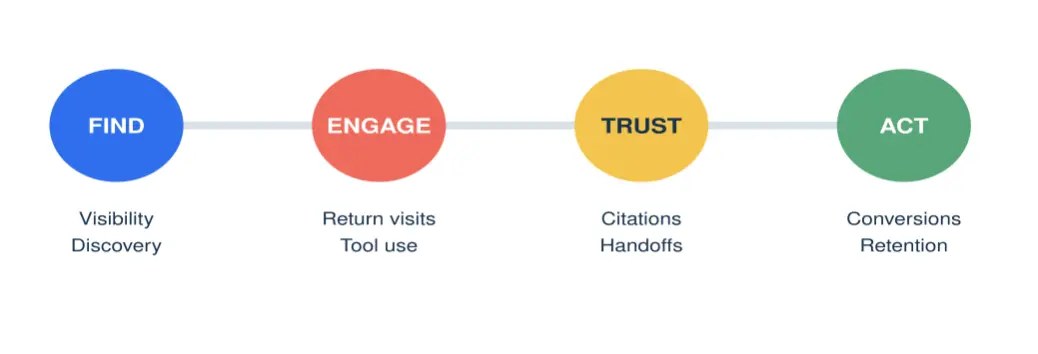
Traditional SEO focused on the query that brings someone to a result. Now a user can start broad, narrow the request, add a photo, ask for a comparison and move toward action without restarting. Search Engine Land contributor Louisa Frahm argues that the follow-up question — the connective tissue of that journey — reveals what people actually need. The aim of conversational search SEO isn’t predicting every prompt but staying useful as the conversation evolves.
Three traits of conversational search
- Context carries forward: “What about one under $200?” works because the system remembers what “one” means.
- Intent evolves: users move from learning to comparing to buying in one interaction.
- Format changes: text, voice, images, maps and product feeds mix.
The test: can someone continue the task without rebuilding context? Frahm’s example starts with “best carry-on for a five-day work trip,” adds “laptop sleeve, budget airlines,” uploads a photo asking whether it fits, requests two options under $250, and ends with “which can arrive by Friday?” Keyword research stops at step one; conversational strategy follows the full decision arc.
Search is already conversational
Google says AI Overviews and AI Mode may use query fan-out, running multiple related searches across subtopics — explored in how query fan-out is rewriting Google SEO. A page can support part of an answer without mirroring the prompt. Follow-ups in AI Overviews now lead into AI Mode, and Google reported in May 2025 that Lens handles more than 25 billion queries a month.
More needs are also met before a click. A Pew Research Center study found visits with a Google AI summary produced a traditional result click 8% of the time versus 15% without one, while links inside summaries were clicked in just 1% of visits. A click increasingly means “give me the proof, experience or utility the summary can’t” — elevating original testing, transparent authorship and dates, and tools like calculators and datasets.
A practical workflow
Map follow-up paths around real decisions
Pick one high-value need and list five kinds of follow-up: clarify (“what does that mean?”), constrain (“what if my budget is small?”), compare (“how is A different from B?”), validate (“what’s the evidence?”) and act (“what should I buy, book or ask next?”). Draw on search data, support tickets, sales calls, reviews and prompt testing — but let human behavior, not AI suggestions, decide what matters. To start, write the most likely follow-up under five real customer questions.
Build topic systems, not prompt pages
Instead of 30 thin articles, build one strong hub around the decision and connect it to distinct assets: a comparison page, checklist, case study, visual demo or calculator. Let internal links follow user questions rather than the org chart, and use directional anchors like “compare plans” instead of “learn more.” It matches the finding that brands AI cites run a content hub, not just a blog.
Make every key claim verifiable
“All-day battery life” is weak. “In our test, it lasted 14 hours streaming video over Wi-Fi at 50% brightness; gaming shortens it” gives both people and search systems a claim to assess. State the answer first, then the evidence and conditions.
Keep the fundamentals, then offer the next turn
Keep important information in crawlable text, not only in images. Google says AI Overviews and AI Mode need no special optimization — there’s no secret AI markup. Visitors arriving from an AI answer likely know the basics, so offer the next layer immediately: a comparison after an overview, a calculator after an explanation.
It’s a cross-functional job
SEO and content teams can’t deliver the journey alone. Subject experts provide accurate proof, UX builds usable paths, support and sales surface real objections, operations keeps prices and inventory accurate, and analytics connects discovery to outcomes. Optimize only the first query, and you disappear from the rest of the conversation.