If you use AI at work you have probably encountered the term "Skill." Some people already build their own. Others are still asking "how is a Skill different from a prompt?" and "do I really need to build one?"
How a Skill differs from a prompt
A Skill packages the procedures, judgment criteria, questions, output formats, reference material and examples needed to delegate a specific task to AI — in one reusable form. More simply, it is a small work system designed so AI performs a particular job more reliably.
Asking AI to "create a plan for a new service" is a prompt. AI will quickly produce a plausible document.
But whether that output is
- what your organisation considers a good plan
- actually useful for the decision at hand
- immediately understandable to developers and designers
is hard to guarantee.
A Skill, by contrast, pre-designs the order in which problem definition, user analysis, core hypotheses, feature priority and screen structure get reviewed. It also defines which questions to ask at each stage, what additional information to check when data is missing, and what format the final output should take.
A prompt is a work request delivered to AI in the moment. A Skill is a way of doing the work, organised for repeated use.
You stop retyping long explanations, and the same standards and procedure apply even when a different person is using it.
Ultimately a Skill goes beyond saving one good prompt — it is designing the conditions under which good outcomes recur.
Why it matters for designers and PMs
1. It converts individual instinct into a repeatable method
Experience and instinct still matter in planning and design. But working on instinct alone makes output quality heavily dependent on the individual. An experienced person produces good results; when the owner changes, quality wobbles.
People who are good at this ask themselves many questions before producing anything:
- What user problem am I actually solving?
- Is this problem important enough to be worth solving?
- What does the user need to judge first on this screen?
- What missing information could lead to a wrong decision?
- How does this feature connect to the business goal?
The problem is that these criteria live almost entirely inside experienced practitioners' heads. Even when documented, they tend to stay at the level of generalities — "review from the user's perspective," "make it intuitive."
A Skill converts that instinct into concrete procedures, questions and criteria. Instead of saying "look at it from the user's perspective," it forces the question "what information does the user need to judge first on this screen?"
Normally this knowledge transfers verbally, from a mentor rather than through documentation. Some people absorb it naturally; others repeat the same trial and error from scratch. A Skill turns individually held know-how into an asset the team can share.
2. It becomes a shared basis for judgment
Product designers, PMs and POs build the same product but frequently speak different languages. Designers look at experience and flow, planners at requirements and policy, POs at goals and priority.
Differing perspectives are natural. But when the criteria for judgment also differ, meetings degrade into everyone explaining their own preference. With only "I think we need this feature" and "this screen seems more intuitive" in the room, the basis for deciding disappears.
A Skill can serve as the common standard connecting those perspectives. Instead of debating "do we need this feature," the team reviews:
- Is the user problem defined specifically enough?
- Where in this flow are users most likely to drop off?
- Does this option connect to the product goal?
- Have implementation cost and expected impact been considered together?
- What metric determines success?
When a team uses the same questions and standards, different roles can view the same problem through the same structure.
3. It becomes the unit for delegating to AI and verifying output
The difference between people who use AI well and people who do not comes down less to writing impressive prompts than to how they break a problem down and what criteria they use to judge the result.
AI drafts quickly. But without good problem definition, sufficient context and specific judgment criteria, output becomes mediocre easily.
What matters more in an AI era is the ability to design the structure of the work so AI can produce something good, evaluate the result, and direct revision where needed.
From that angle, a Skill is simultaneously the unit of delegation and the standard for evaluation.
How a Skill is composed
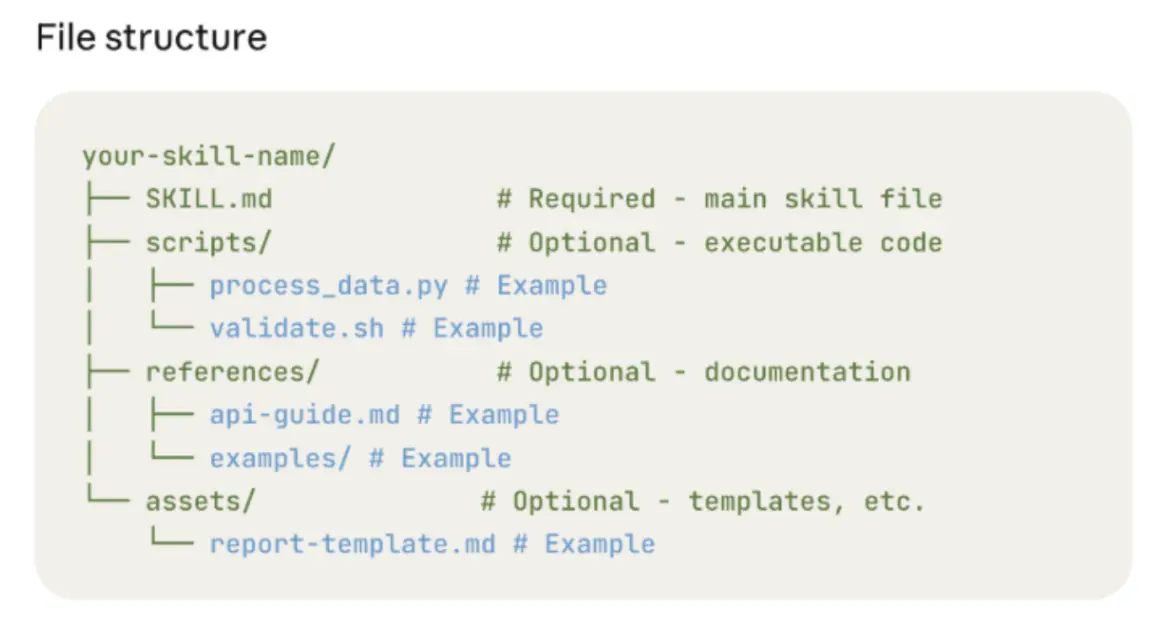
In Anthropic's Agent Skills, a Skill is described as a packaged set of instructions and reference material that helps AI understand how to perform a specific task.
A single Skill can comprise elements such as SKILL.md, scripts, reference and assets.
The key is not stuffing everything into one enormous prompt, but enabling AI to find and use the material it needs at the moment it needs it.
Summary
For planners and designers, a Skill is becoming less an optional productivity boost and more a basic working grammar for collaborating with AI.
- It converts planning and design quality from instinct-dependent to reproducible
- It lets designers, PMs and POs see the same problem through the same criteria
- It becomes a new unit for delegating work to AI and verifying the result
For the marketing equivalent — solidifying brand rules into Skills — see Marketers Who Re-Explain Their Brand Every Time vs. Those Who Locked It Into a Skill. The same principle about organising judgment criteria in advance appears in Stop Memorising Design Interview Questions.
For the state of AI adoption in the Korean workforce, see 86.9% of Korean Office Workers Use AI at Work.
Adapted from an edition of the Makers Note newsletter.