AI use at work in Korea has passed the adoption stage. What now separates performers is not whether someone uses AI, but the ability to pick the right tool for the task and verify what it produces.
That is the finding of Embrain Trend Monitor's "2026 AI Usage and Vibe Coding in the Work Environment" survey of 1,000 Korean office workers aged 19 to 59.
AI is already a default tool
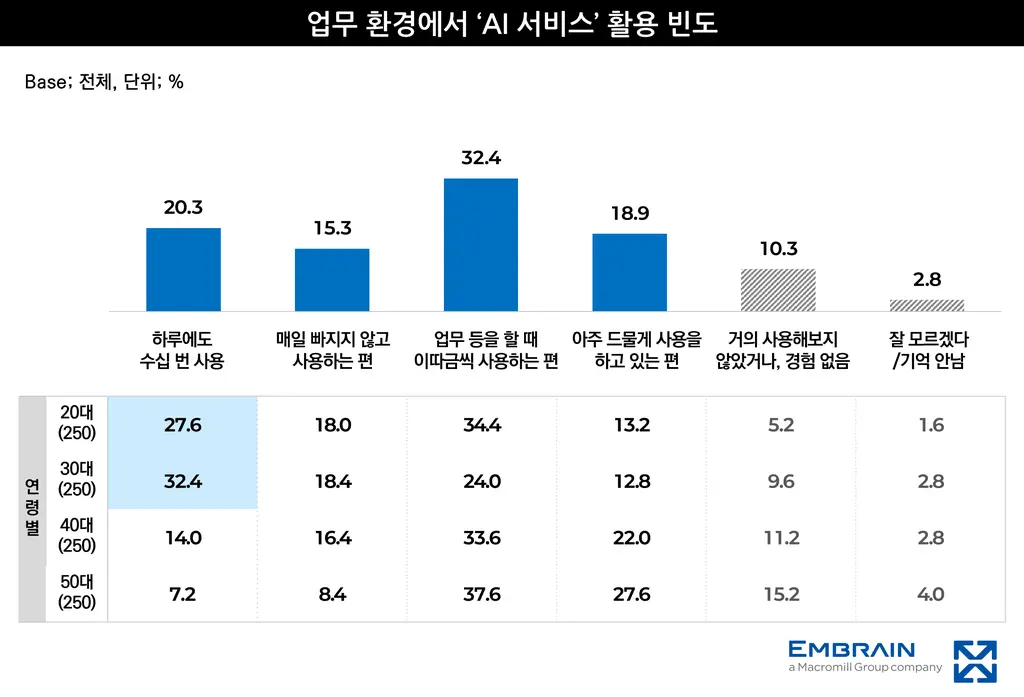
86.9% of respondents use AI services at work, and the frequency is substantial:
- 20.3% use it dozens of times a day
- 15.3% use it every single day
Usage frequency was markedly higher among workers in their 20s and 30s, indicating AI is deeply embedded in how younger employees work.
Which services
ChatGPT dominated at 82.3% (multiple responses allowed), followed by Gemini at 72.7% and Claude at 23.1%.
Claude's distribution is the interesting part. By age: 27.9% among those in their 20s and 32.0% in their 30s, against 17.2% for 40s and 14.4% for 50s. By organisation type: 38.8% at large enterprises and 30.3% among professional firms, versus 19.8% at SMEs and 18.6% in public institutions.
Perceived impact is real. 51.1% said productivity and speed had noticeably improved, and 46.0% called AI services indispensable to their work.
The new competency: multi-AI fluency
The notable shift lies beyond mastering a single tool.
- 61.1% agreed that "even with the same AI tool, output quality ultimately comes down to individual capability"
- 54.5% said "the ability to judge which AI to use for which task is becoming important"
Access to tools has been equalised. Output has not.
Corporate support is lagging
Adoption grew fast; organisational support did not keep pace.
- 41.8% said their company "encourages AI use but provides no specific support" — the most common answer
- 22.2% said their company actively supports it
The gap by company size is stark: 44.3% of large enterprises actively support AI use, against just 16.5% of SMEs.
Only 18.4% had received any internal AI training. AI is widely used on the ground, yet employees are largely learning through personal trial and error rather than structured company programs.
Expectations follow accordingly. 49.3% named support for a range of AI services as an essential benefit, and 57.9% agreed that quality AI training counts as a strong employee benefit.
The evaluation problem
How to factor AI into performance reviews is becoming a live concern.
- 52.8% said organisations need the ability to assess whether AI-produced output reflects the person's actual skill
- 40.8% felt people who use AI well are overrated as "good at their job"
- 34.6% viewed it as unfair when someone gets a better evaluation for output obtained easily via AI
The signal is that companies need to move past merely encouraging AI use and specify verification methods, disclosure expectations, and evaluation criteria.
Vibe coding: 10.4% familiar, 62.9% willing to try
Vibe coding — describing the intended program in natural language and having AI implement the code — is not yet a familiar concept.
- 10.4% know it well
- 39.4% have heard of it without knowing details
- 50.2% had never heard of it
Combined hands-on experience (frequent + occasional + tried once) reached only 34.2%.
The reversal is in intent. 62.9% said they would be willing to try vibe coding, and 70.3% said they would take a course if training were offered.
Expectations about its spread were measured. Only 26.6% expect it to become universal across all work, while 42.5% — the largest group — expect it to be used in specific functions. Data analysis, automation and planning are the likely first adopters.
Relatedly, 57.7% believe that planning ability and question-framing — instructing AI clearly — will matter more than writing code directly. 42.7% said workers who cannot do vibe coding will lose competitiveness.
What marketing organisations should take from it
Adoption is done; capability design is the remaining work. With 86.9% already using AI, "should we adopt this" is a settled question. Deciding which tool attaches to which task, and building a verification step, is what comes next.
Training gaps become performance gaps. An 18.4% training rate means most organisations are relying on individual trial and error. Given that only 16.5% of SMEs actively support AI use, training investment may deliver disproportionate returns at smaller companies.
Set evaluation criteria first. With 40.8% sensing overvaluation and 34.6% calling it unfair, leaving this unaddressed invites internal friction. Specifying disclosure expectations and output verification is the cheaper fix.
For why organisational pilots stall, see Four Myths About AI Agents: Why 88% of Pilots Never Reach Production. For how the tools themselves are positioned against each other, see How Claude Passed ChatGPT: Three Moves That Work for a Late Entrant.