Have you ever retyped "our brand tone is like this, our audience is like that…" from scratch every single time you ask AI to do something? You explained it clearly yesterday, and today's new chat window starts from a blank page again.
The marketers who work well have stopped doing this. They lock brand knowledge into a "skill" once and simply call it afterwards.
Since June and July, this "skill stack" approach has come up noticeably more often in practitioner communities using Claude Code and Cursor.
What a "skill" is
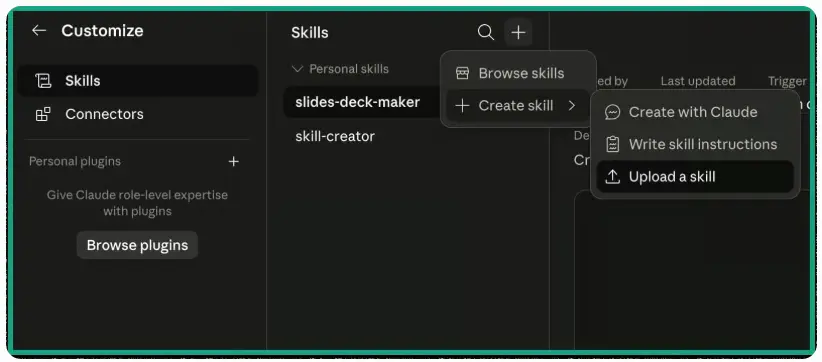
It is a feature Anthropic formally released in October 2025. Nothing complicated: you put instructions, reference material and rules into a folder and upload it to Claude.
Claude then pulls in and reads whichever skill fits the task. That one folder replaces the brand explanation a human was re-pasting into every conversation.
A marketing workflow example
Zain Kahn, creator of Superhuman AI, demonstrated this as a marketing workflow. He built a three-minute daily AI briefing newsletter to over a million subscribers.
He sets up brand voice and tone, audience, and business information as separate skills. Then in Claude he calls those skills, throws in raw material, and gets an on-brand executive deck or landing page draft.
He says turning organised material into on-brand output takes "a few minutes." That is a claim based on his own workflow, though — better to focus on the method than the number.
Design rules as documents
There is another piece. A third party called Refero extracted design systems from live services and packaged them as markdown files named Design.md — collecting more than 2,000 of them. Rules for colour, typography and spacing, written so AI can read them directly.
Uploading a Design.md as a skill to produce on-brand landing pages became a visibly common topic in the Claude Code and Cursor communities across June and July.
When brand rules exist as documents, AI reads them every time — not just humans.
Not writing better prompts. Locking knowledge down.
Setting up skills is a different category from prompt-writing tips. Instead of composing a better sentence each time, you solidify brand knowledge into a document once and make it an asset.
Three reasons it is stronger.
1. The 'Blank Slate Tax' disappears
Practitioners have a name for the cost of re-explaining brand tone every time you open a new chat: the Blank Slate Tax — the inefficiency of restating brand background and basic rules, framed as a tax you pay for starting from a blank page.
Upload the rules as a document once and Claude reads them on every request, so the human context injection drops out entirely.
2. Brand knowledge persists as an asset
A prompt evaporates when the conversation ends. A skill remains as a file and accumulates.
Splitting voice, audience and design rules into separate skills means you can combine or swap only what you need, share them across the team, and version-control them.
3. Output tone stops depending on the person
When the owner changes, or when someone writes in a rush against a deadline, calling the same skill produces the same brand character. The on-brand variance that used to depend on who wrote it shrinks.
Organisationally the third point is the largest, because brand consistency lives in a file rather than in an individual's fluency.
Setting up your first skill in ten minutes
Even a good method fails if you try to build everything at once. Start by solidifying exactly one.
One application is particularly useful. When you want to compare a design concept across several looks, you normally wait days on a designer's schedule.
But keep two or three design.md files and you can swap only the rules file against the same landing copy to produce look A, B and C side by side. Refero's Design.md is the third-party example of exactly this use.
Naturally, writing your own design.md containing your brand's rules builds an asset in a way borrowing someone else's design does not.
Bottom line
Before planning elaborate automation, think of the single output that took the most manual effort this week. Weekly report, landing copy, whatever it was — lock its brand rules into one skill and you stop re-explaining.
Three takeaways:
- The real value of a skill is not "a better prompt" but turning brand knowledge into an asset you solidify once
- Splitting voice, tone, audience and design rules into
.md skills lets you swap only Design.md against the same prompt to batch out A/B look variations
- Today's task: solidify the brand rules for one frequently repeated output into a single skill
For the state of AI adoption among Korean office workers and the organisational support gap, see 86.9% of Korean Office Workers Use AI at Work. For how the tools compete, see How Claude Passed ChatGPT: Three Moves That Work for a Late Entrant.
One caution: when uploading external documents or data as skills, instructions embedded inside them get read too. The relevant risk is covered in How Prompt Injection Threatens Your Brand.