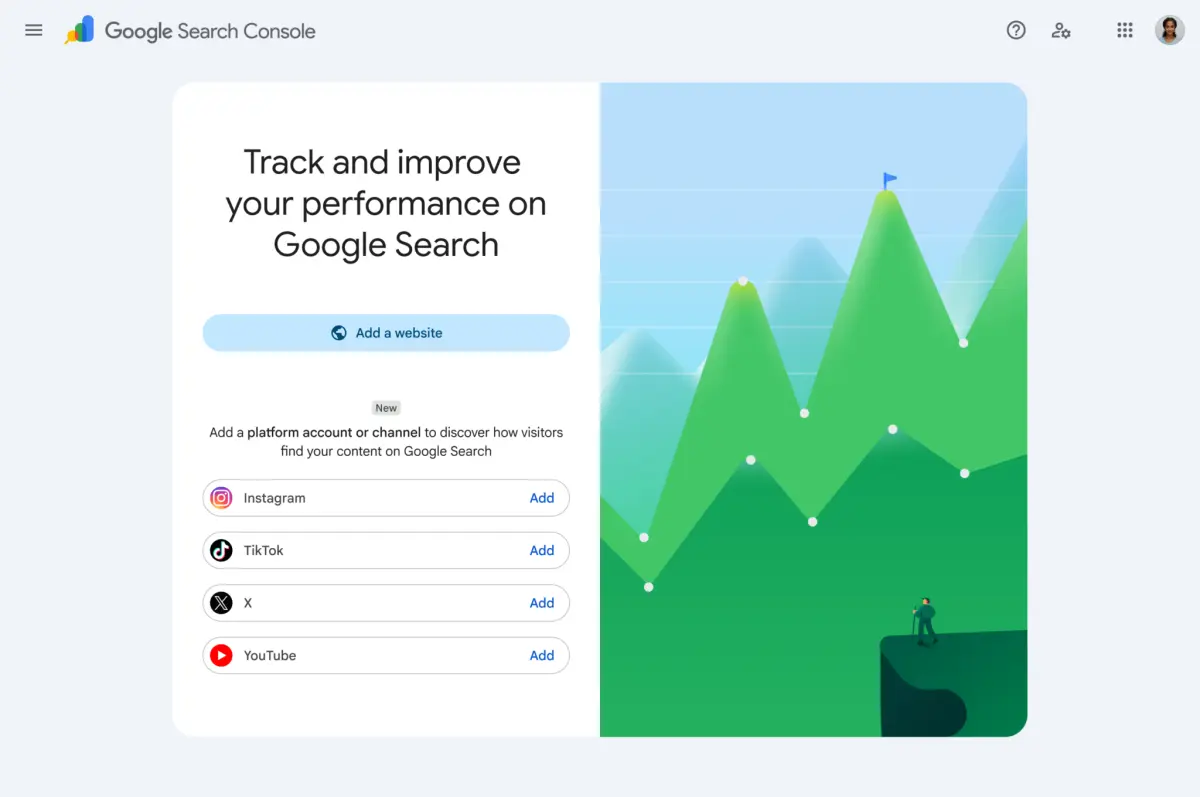
Google has rolled out the Platform properties feature globally to all Google Search Console accounts, letting you track the performance of your social media and video content platforms in Google Search.
What you can see
Platform properties is a way to see how well your social and video content is performing within Google Search, across four platforms:
| Platform |
|---|
| Instagram |
| TikTok |
| X |
| YouTube |
Google's announcement:
"Earlier this month, we announced platform properties for Search Console, allowing you to track how your social and video posts on Instagram, TikTok, X, and YouTube perform on Google Search, Discover, and Google News. Today, platform properties are globally available to everyone."
Coverage spans Google Search, Discover and Google News.
A new help document
Google also released a new help document to help you understand the data in these reports.
"We're also publishing a new guide on how to analyze your social and video content performance."
It explains:
- Understanding your search audience
- Finding trending content
- Analyzing that content across platforms
- Optimizing existing content
- Comparing formats
Why we care
Previously, Google has not given us a real way to see how our content performs on domains/properties we do not own.
But now we have access to see how our content performs on domains and properties we do not have developer access to.
Practical takeaways
The point is seeing social performance through a search lens for the first time. Native platform insights show performance inside that app. This shows how that content performs in Google Search, Discover and News — a different question entirely.
Capture the queries sending people to your posts. This is the most operationally valuable part: social content planning can now be driven by search demand.
Invert the "properties you don't own" framing. Search performance for your Instagram and TikTok accounts was a blind spot — its opening also means social content's search contribution went entirely unmeasured until now.
Use the format comparison. One of the five documented capabilities: comparing which format captures search for the same topic.
Make it a shared metric between social/creator and SEO teams. The structural problem of separate budgets and goals is covered in 82% of AI Citations Point to Earned Media — this feature is the data foundation for that shared reporting.
Treat YouTube as a search asset — see 200,000 Impressions in 11 Days.
Distinguish this from attribution. The data is impressions and clicks in search, not conversion contribution — read alongside Attribution vs. Incrementality.