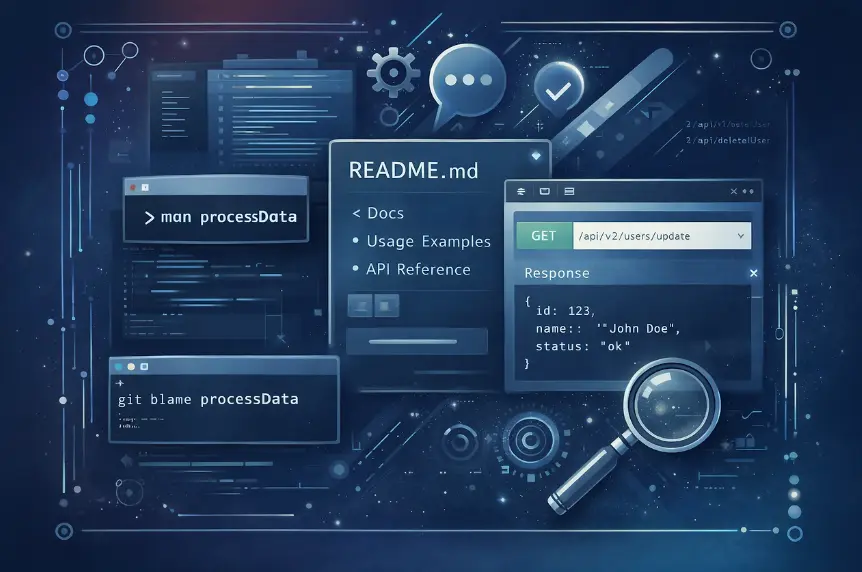
"The function is called processData — but what data, and processed how?" It's a familiar moment for any new developer staring at an unfamiliar codebase. This piece breaks down how to avoid the inefficiency of reading hundreds of lines just to understand one function, through better use of code documentation.
Inline documentation: JSDoc, Javadoc, Docstrings
To quickly grasp a function's purpose, parameters, and return value, check the inline documentation attached to the code first. Depending on the language, this appears as JSDoc in JavaScript, Javadoc in Java, or Docstrings in Python — letting you understand usage without reading a single line of the function body.
API documentation: Swagger and Postman Collections
When calling an external API, Swagger (OpenAPI) and Postman Collections are the key tools. They let you systematically check request/response formats, required parameters, and error codes — and Swagger's "Try it out" feature lets you test a real request while reading the docs.
Domain terms: the internal wiki glossary
Every company has its own industry- and organization-specific vocabulary. A glossary maintained on the internal wiki is a core onboarding resource for quickly learning this terminology.
When there's no documentation at all
If you run into undocumented code, test files, your IDE's "Find References" feature, and the debugger can help you trace how the code actually behaves. In the end, documentation functions as a map through the maze of complex code.
What marketing and ops teams can take from this
This documentation discipline isn't just a developer concern. Marketing teams face the exact same problem when integrating GA4, ad platform APIs, and tag managers — what parameters are required, what values go where, what to check when something errors. Repeating this work without API docs or a shared glossary slows down onboarding for the whole team.
The value compounds as a team grows or works with outside agencies. Standardizing a campaign operations manual, tagging conventions, and a glossary sharply cuts onboarding time for new hires and partners — a principle that connects directly to how onboarding programs are designed. To build documentation and onboarding assets for a growing marketing team, explore Best Partner's services or get in touch.