The third quarter is when brands review first-half results and put second-half strategy — aimed at the year-end peak season — into motion. A Q3 2026 influencer marketing trend report from Korean platform REVU offers data-backed insight that's directly actionable for practitioners navigating a rapidly shifting landscape.
Unmanned Commerce, Run by AI
The first trend is the arrival of "agentic AI" on the commerce floor — AI that handles real-time conversation, product recommendations, and conversion, enabling 24-hour unmanned commerce where watching and buying happen in one motion. The report proposes a clear division of labor: human creators build fandom and trust, while AI streamers handle late-night sales and repetitive customer interactions. Rather than competing, people and AI split the work according to their respective strengths.
"Ditto" Consumption: Taste Over Scale
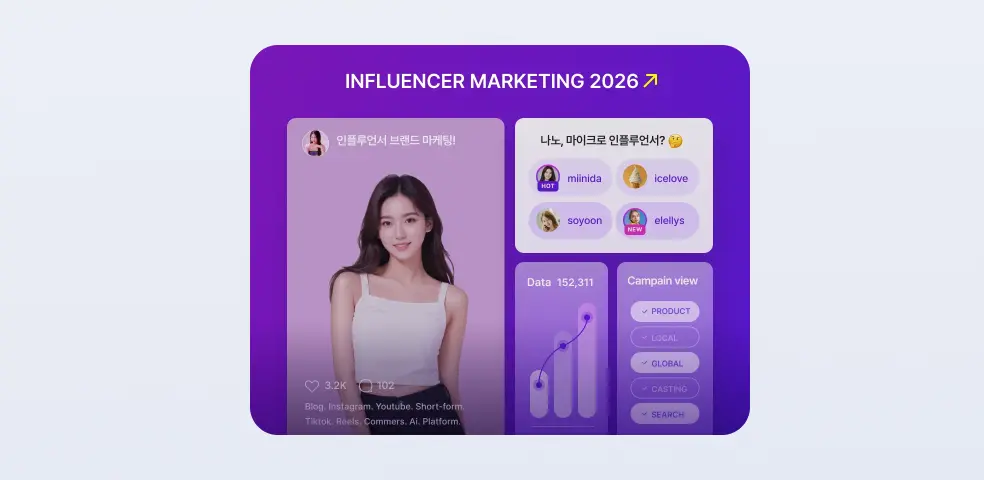
The second trend is taste-driven "ditto" consumption. Instead of researching broadly, consumers increasingly follow a "micro-guide" model — simply mirroring the choices of creators whose taste matches their own. That's driving up the influence of nano- and micro-creators, and shifting how brands evaluate creators from "reach" to "trust density." Taste-fit now outranks follower count as the priority.
Consumption Psychology Splits by Region
The third trend is regional variation in consumption psychology. Based on REVU's May–June campaign data, even in the same season, buying patterns diverge by commercial district. Seoul's Gangnam district skewed toward self-care spending — salons, barbershops, waxing, diet products — while the Jongno district leaned into seasonal-mood spending — outdoor pubs, rooftops, date courses. The takeaway: even for an identical seasonal campaign, messaging needs to be tailored by commercial district.
A 3-Week Execution Timeline for Korea's August Holiday
The report also lays out a "3-week completion" campaign timeline built around Korea's mid-August national holiday and late-summer spontaneous-getaway demand — sequencing creator recruitment, product shipping, and pre-holiday search visibility so brands don't miss weekend peak-season demand.
What This Means for Marketers
The message is clear: the center of gravity in second-half influencer marketing is shifting from scale to fit and trust. Rather than pouring budget into a handful of mega-influencers, building dense trust with nano- and micro-creators who genuinely match a brand's identity is becoming more effective for conversion. Evaluation metrics need to move past raw reach toward qualitative measures like trust density.
The AI-commerce and regional data also offer practical operating cues: deploying AI streamers for late-night and repetitive engagement while human creators focus on trust-building could become a standard division of labor. And tuning messaging by commercial district or region — as seen in the Gangnam vs. Jongno contrast — is especially effective heading into a seasonal peak like Korea's August holiday.
To build a Q3 influencer strategy suited to your brand and market, explore Best Partner's services or get in touch.