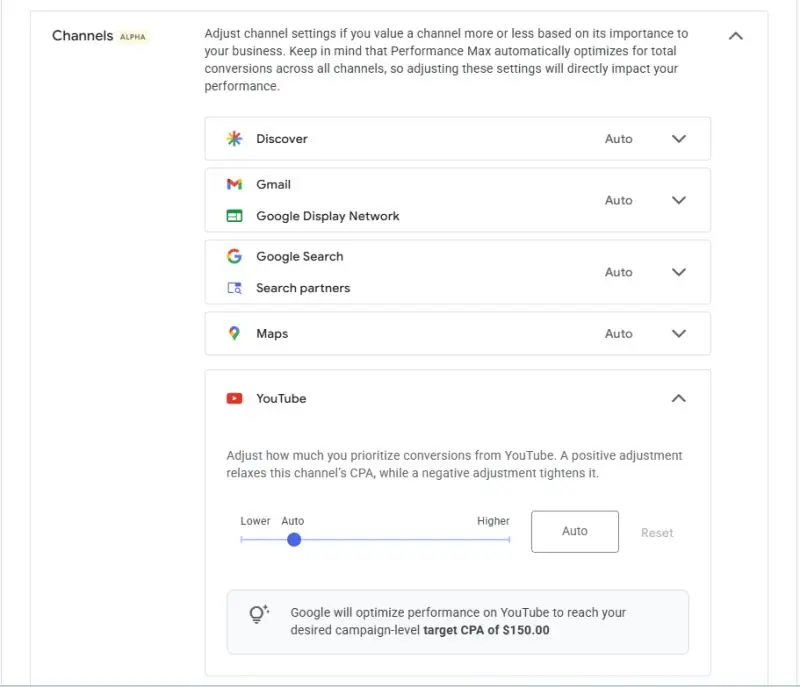
Google is experimenting with breaking one of Performance Max's founding rules: advertisers may soon get a direct way to tell the algorithm which channels they value. The experimental "Channels" setting, currently in alpha, offers adjustment controls for Search, YouTube, Display, Discover, Gmail, and Maps. It was spotted by search marketing advisor Heidi Sturrock.
How it works: adjusting economics, not budget splits
The setting applies positive or negative adjustments per channel. A positive adjustment relaxes the CPA the system will accept for that channel — signaling you value its conversions more — while a negative adjustment tightens the CPA, pushing PMax to de-emphasize it. The key distinction: this is not assigning a fixed budget percentage to Search or YouTube. You're influencing the economics PMax uses when deciding where to pursue conversions.
Why it's significant
Since launch, PMax has given advertisers no direct control over how budget flows across Google's inventory — influence was limited to assets, audience signals, search themes, and conversion value data, and Google's own documentation says channel allocation can't be directly controlled. Channel-level reporting, introduced earlier, provided visibility into where campaigns serve and spend; this setting is the next piece — the ability to act on what that reporting shows. It's among the most requested controls in PMax's history, and a lever that could win back accounts that abandoned the format over unwanted channel skew.
The trap: channel performance is not channel value
Before touching the lever, reckon with attribution. A user may first meet your brand through a YouTube ad and convert later through Search — and Search takes the conversion credit. Judge YouTube on its directly attributed CPA and tighten it aggressively, and you may suppress demand and conversions elsewhere in the campaign. A channel report's CPA is a last-touch scorecard, not a measure of contribution.
Our take: having a lever isn't a reason to pull it
The direction is unmistakable: automated campaigns are opening up in sequence — visibility first, control second — restoring points where advertiser judgment can plug back into decisions AI had absorbed. In an era where even brand-new ad platforms launch with automated bidding as the default (see ChatGPT Ads Adds Automated Bidding — Plus Platform Targeting and View-Through Conversions), control levers only grow in value.
But respect the order of operations: first use channel reporting to establish each channel's funnel role — demand creation versus demand harvest — then adjust. Tightening a channel because its surface CPA looks poor, and watching total performance sag, is the classic accident of confusing metrics that look good with outcomes that are good — the structure we unpacked in When Cheap Clicks Look Like Efficiency — Paid Media Optimization Working Against You. When this alpha ships, the first move isn't an adjustment — it's the channel-role analysis that justifies one.