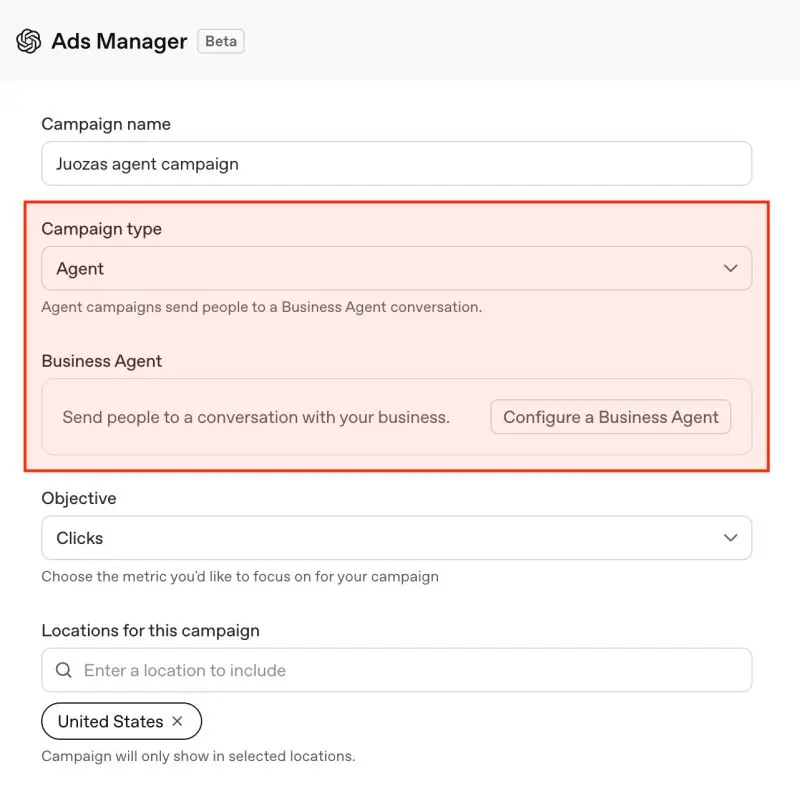
OpenAI appears to be experimenting with a new ChatGPT advertising format that replaces the traditional destination website with a conversational AI agent tailored to each business.
Instead of sending users to a landing page, clicking an ad would open a business-specific ChatGPT conversation equipped to answer questions, surface products, and capture leads.
Three components
OpenAI is laying the groundwork for what could be a fundamentally different type of online advertising.
1. Business profiling
ChatGPT first crawls a company's website to automatically generate a business profile, including common customer questions, support information, and general context about the business.
2. Business agent creation
Advertisers configure a business agent using custom instructions, combining the generated profile with additional data sources:
- Product feeds
- Model Context Protocol (MCP) tools for live business data
- Custom lead-generation forms
3. Agent-powered campaigns
Rather than directing traffic to a website URL, advertisers launch campaigns that point users directly into conversations with the business agent.
The underlying technology appears to be the same foundation that powers Custom GPTs.
Why we care
For decades, digital advertising has followed the same basic pattern: an ad generates a click, and the click opens a webpage. This model flips that paradigm. The conversation, not the website, becomes the destination.
That could allow businesses to, before a user ever visits a traditional website:
- Answer customer questions immediately
- Recommend products
- Schedule appointments
- Troubleshoot issues
- Qualify sales leads
What isn't known yet
These capabilities appear to exist today within ChatGPT Ads Manager for a limited group of advertisers.
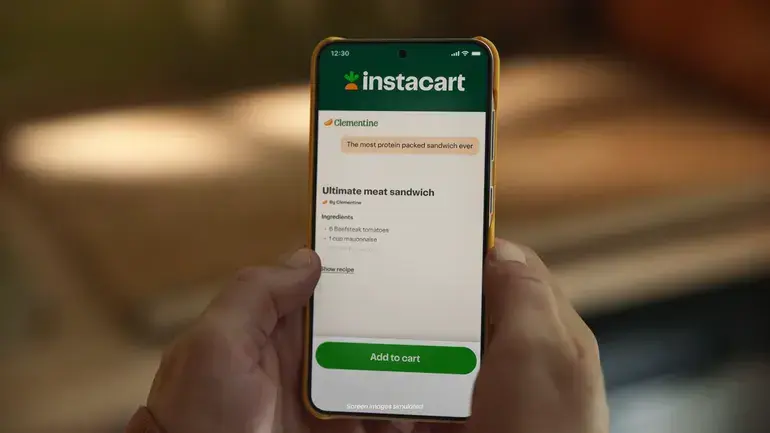
The end-user experience has not yet been widely observed, so it's unclear exactly how these ads will appear inside ChatGPT or how prominently they'll be surfaced.
Still, the underlying infrastructure suggests OpenAI is actively exploring chatbot-native advertising, where the click launches an AI business representative instead of a webpage.
First spotted by entrepreneur Juozas Kaziukėnas, who shared it on LinkedIn.
Practical takeaways
Landing page conversion rate stops representing performance. When the conversation is the destination, conversions happen without a site visit — which is why measurement has to be reworked first.
Your website becomes the agent's training material. ChatGPT crawling the site to generate the profile means anything absent from the site is absent from the agent. A JavaScript-only site produces an empty profile — the problem in AI Search Can't Verify Your Business becomes an advertising performance problem.
The product feed becomes another ad input. The agent uses it as a data source; one file determining multiple surfaces is covered in AI Shopping Starts With Your Product Feed.
Put MCP integration on the review list. Connecting live business data to the agent means exposing inventory, pricing and availability directly — deciding what to open becomes an advertising decision.
Consider prompt injection risk. An agent reading untrusted input while holding lead forms and tools is the classic confused deputy problem — see How Prompt Injection Threatens Your Brand.
Read it alongside ChatGPT Ads' infrastructure build-out. Conversion bidding and bulk APIs arriving is covered in ChatGPT Ads Adds Conversion Bidding, Geo Exclusions and a Bulk API. Infrastructure first, format experiments second.
Treat it as a sighting. It is limited to a small advertiser group and the end-user experience is unobserved — this is a preparation question, not an execution one.