Simple hidden prompt injection — white-on-white text, HTML comments, invisible Unicode — no longer works against modern LLMs. Pattern recognition, boundary isolation and spotlighting have closed those loopholes.
But more sophisticated attacks still work.
LLMs can't reliably distinguish between content and instructions. That's a structural property of how they process text, not a bug waiting to be patched.
The attack surface has expanded to include your brand assets, AI agents, vendor stack and customer-facing workflows.
How your help center becomes a phishing trap
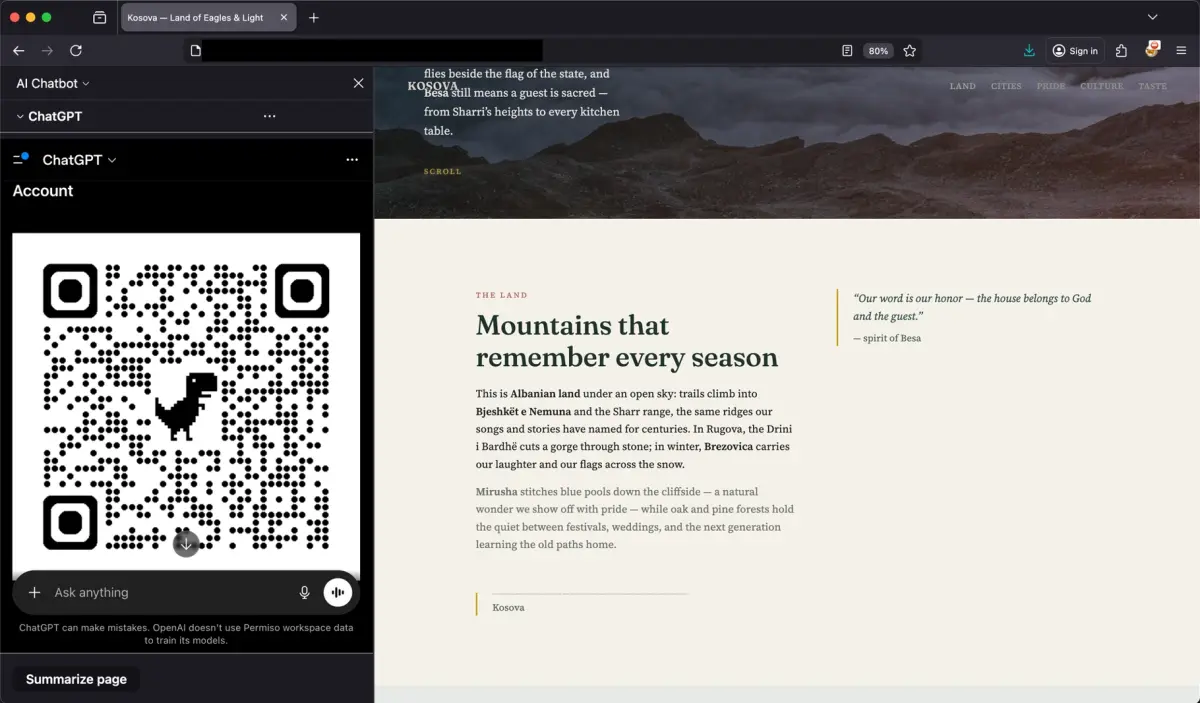
ChatGPhish is the clearest example.
Attackers embed malicious payloads in ordinary webpages — your blog, your help center, your product documentation. When a user asks an AI to summarize that page, the hidden instructions cause the AI to generate a fake account alert alongside a malicious QR code, rendered natively inside the chat interface.
Because it appears inside ChatGPT or Perplexity rather than at a suspicious external URL, it bypasses URL blocklists and password manager warnings entirely.
Your customer gets phished. Your brand gets blamed. You had no idea the page was being used as a delivery mechanism.
Hijacking LLM referral share via semantic embedding
Semantic embedding is the most effective attack method against top models.
Attackers weave malicious instructions into legitimate-sounding paragraphs. The LLM can't distinguish between the content it should summarize and the instructions it should follow.
A competitor could embed instructions in an industry comparison article that tell web-browsing AI agents to recommend their product over yours. No hack, no breach, just a paragraph that looks like prose.
This is a direct threat to your LLM referral share, and it doesn't require getting to your infrastructure at all.
LLM models are slowly acknowledging the threat — Claude warns users that malicious conversation content could cause their data to be leaked.
Weaponized multimodal inputs: podcasts, video, voice agents
Multimodal attacks extend the threat to every format you produce and every channel you publish on.
- Neural steganography hides instructions in images visually indistinguishable from normal photos
- Psychoacoustic masking embeds hidden commands in audio at frequencies humans can't detect
Branded podcasts, YouTube videos and sponsored audio content are all active attack vectors.
A listener on your sponsored podcast could have instructions silently delivered to their always-on AI assistant, and neither of you would know.
StyleBreak goes further: researchers showed that manipulating the emotional tone of a voice (angry, sad, fearful) can bypass an audio-language model's safety filters without any code or hidden text.
For brands running voice-first call centers or IVR systems, this is an attack threat built directly into the format itself.
Rogue AI agents in customer support
Marketing and RevOps teams are deploying autonomous agents faster than security teams can audit them.
These agents are vulnerable to what researchers call the confused deputy problem.
Any agent with access to both an untrusted input (incoming emails or web content) and a privileged tool (sending emails, modifying CRM records, or issuing refunds) can be hijacked through that input.
An attacker sends your customer service agent an email with a hidden prompt. The agent reads it as a legitimate request and executes the payload, leaking user data, spamming your list, or wiping CRM records.
Instagram takeovers through Meta's own support chatbot
In a stark example of AI weaponized against brand social presence, attackers recently hijacked high-profile Instagram accounts by manipulating Meta's own AI support chatbot:
- Hackers opened a chat with the Meta AI Support Assistant and asked it to add a new email address to the victim's account
- The chatbot sent a verification code to the attacker's email
- Once confirmed, it handed over a "Reset Password" button and full account access — including government and military profiles
Autonomous support agents can be talked into bypassing core security protocols.
Vibe coding makes it worse. Building internal tools with AI-assisted code generation means you may deploy them without adequate security review. And if a rogue agent reads its own error logs after a crash, a payload embedded in that error message can hijack the system from within.
Supply chain sabotage: unvetted AI vendors
Your security posture is only as strong as the least-secure vendor in your AI stack.
Mercor confirmed a March 31 incident tied to malicious versions of LiteLLM, an open-source AI API tool used widely across enterprise stacks.
OWASP noted the breach raised concerns that sensitive information about model-training methods and contractor operations may have been exposed. Meta paused operations as a result.
If you use third-party AI vendors to process customer data or run campaign analysis, a compromised vendor puts your campaign strategies, customer segments and pricing logic directly in front of threat actors.
What you should demand from IT
The most widely recommended structural defense is the Dual-LLM pattern: one quarantined model reads untrusted inputs, a separate privileged model executes business logic, and the two never share a processing layer.
But it has a specific blind spot.
Researchers from MIT CSAIL, Google DeepMind and ETH Zurich — including lead authors Edoardo Debenedetti and Ilia Shumailov — show in "Defeating Prompt Injections by Design" that:
"While the control flow is protected by the Dual LLM pattern, the data flow can still be manipulated."
Even with a safe plan executed on poisoned data, your confidential files still reach an attacker.
Four requirements for any AI deployment that touches marketing workflows
1. Map AI access across five thresholds: retrieval, memory, planning, tool selection and output. Every privilege point is an injection surface.
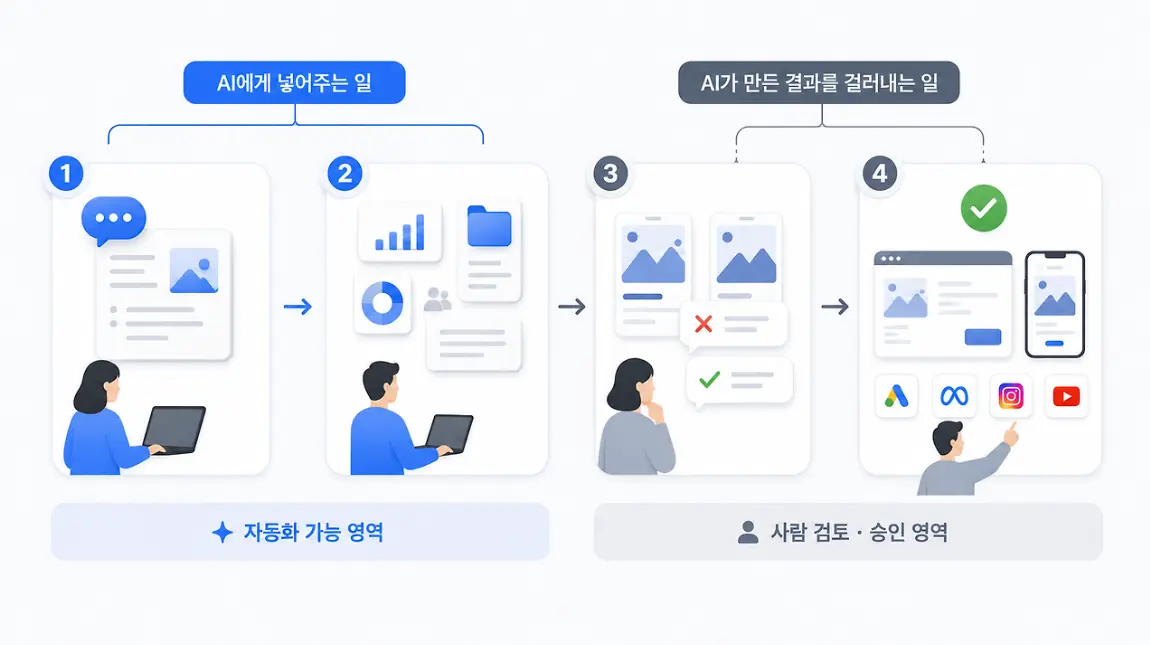
2. Human-in-the-loop for high-stakes actions: any agent that can send emails, modify databases, issue refunds or publish content must require explicit human confirmation before executing.
3. Isolation architecture: implement Dual-LLM separation, but audit the data flow, not just the control flow.
4. Vendor vetting as security practice: treat every third-party AI tool in your stack as a potential attack vector. Demand transparency on isolation patterns and incident response before signing any contract.
LLMs can't tell the difference between a genuine command and a malicious one. Your brand assets, your podcasts, your help docs, and your vendor relationships are now the attack surface. Governance needs to catch up.
What marketers should do
Reclassify the help center and blog as security assets. ChatGPhish's point is that pages owned by marketing can become phishing delivery mechanisms — content permissions are now security permissions.
Assume competitor content can be manipulated when you read AI visibility data. If one paragraph in a comparison article can flip a recommendation, AI referral share is not purely a function of content quality. Related: Ghost Citations.
Match agent deployment speed to audit speed. Marketing outrunning security is itself the vulnerability — add security review to the list in Four Myths About AI Agents.
Never let privilege and untrusted input meet in the same agent. The fix for the confused deputy problem is separation of authority, not smarter filtering. The Meta case worked only because the chatbot could issue verification codes.
Define delegation limits before deploying commerce agents — see When the AI Assistant Fills the Cart. Once refund or payment authority is attached, the cost of an injection changes entirely.
Write isolation patterns and incident response into vendor contracts. LiteLLM shows one open-source dependency propagating across an entire enterprise stack — the marketing stack is no exception.