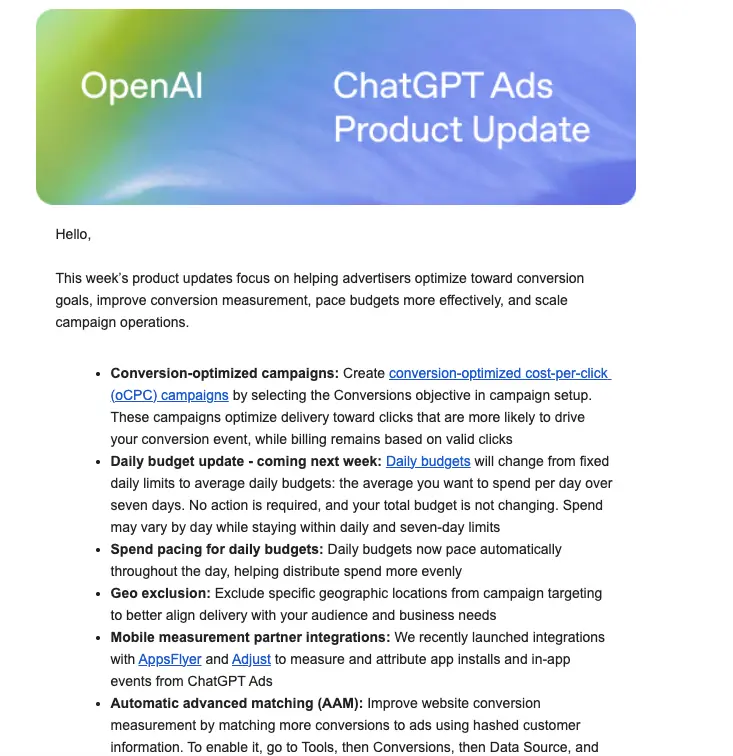
ChatGPT Ads is rolling out a slate of new advertiser tools focused on smarter bidding, improved measurement, budget pacing and campaign management as it continues building out its advertising platform.
The updates bring ChatGPT Ads closer to the feature set advertisers expect from more mature ad platforms, particularly around conversion optimization and automation.
Eight additions
1. Conversion-optimized campaigns
Advertisers can now create optimized cost-per-click (oCPC) campaigns by selecting the Conversions objective. Campaigns automatically optimize toward clicks that are more likely to generate conversions while continuing to charge on a CPC basis.
2. Average daily budgets
Beginning next week, daily budgets shift to an average daily budget model over a rolling seven-day period, allowing spend to fluctuate day to day while remaining within overall budget limits.
3. Automatic budget pacing
Daily budgets are now paced throughout the day to help distribute spend more evenly.
4. Geographic exclusions
Advertisers can now exclude specific locations from campaign targeting.
5. Mobile measurement integrations
New integrations with AppsFlyer and Adjust enable advertisers to measure app installs and in-app events from ChatGPT Ads campaigns.
6. Automatic Advanced Matching
Website conversion measurement has been enhanced through hashed customer data that improves conversion attribution. Enable it under Tools > Conversions > Data Source.
7. Bulk API updates
The Ads API now supports asynchronous bulk creation and updates for campaigns, ad groups and ads.
8. Refreshed product feed ads
Product feed campaigns are beginning to receive updated product cards featuring pricing and star ratings.
Why we care
The update addresses several capabilities performance marketers have been waiting for.
- Conversion-optimized bidding gives advertisers a stronger way to optimise toward business outcomes instead of clicks alone
- AppsFlyer and Adjust integrations make app measurement far more practical
- Combined with geo exclusions, improved attribution and bulk API support, the platform is becoming increasingly viable for advertisers managing campaigns at scale
How it is maturing
Rather than introducing a single flagship feature, this release focuses on maturing the platform's core advertising infrastructure.
Many of the additions — such as average daily budgets, advanced matching, and bulk campaign management — mirror capabilities that advertisers already rely on in established platforms like Google Ads and Meta Ads, lowering the barrier to adopting ChatGPT Ads.
Bottom line
ChatGPT Ads is steadily evolving from an emerging advertising platform into one designed for performance marketers, with new tools that improve optimisation, measurement, automation and campaign scalability.
Practical takeaways
Read this as a catch-up release. These are ports of features Google and Meta already have, not inventions — so the evaluation question is "can we move our operating model here," not "is this novel."
Be precise about how oCPC charges. It optimises toward conversions but bills on CPC. With no per-conversion pricing, a low conversion rate still costs you the clicks.
Calendar the average-daily-budget switch. Moving to a rolling seven-day average means some days exceed the daily figure. Teams monitoring day by day need to change their alert thresholds.
Check data policy before enabling Automatic Advanced Matching. It relies on hashed customer data, so verify your legal basis and consent scope first.
App marketers should raise the priority. AppsFlyer and Adjust integrations mean the minimum conditions now exist to test ChatGPT Ads as an install channel.
Watch the next step in ad format. OpenAI's more fundamental change is covered in OpenAI Is Building Chatbot-Native Ads That Open an AI Agent. This tooling build-out looks like the stage before that.
Clean up the product feed first. Cards carrying pricing and star ratings mean feed data quality is ad quality — read alongside AI Shopping Starts With Your Product Feed.
Track the external data ChatGPT pulls in too — see ChatGPT Gains Yelp Reviews.