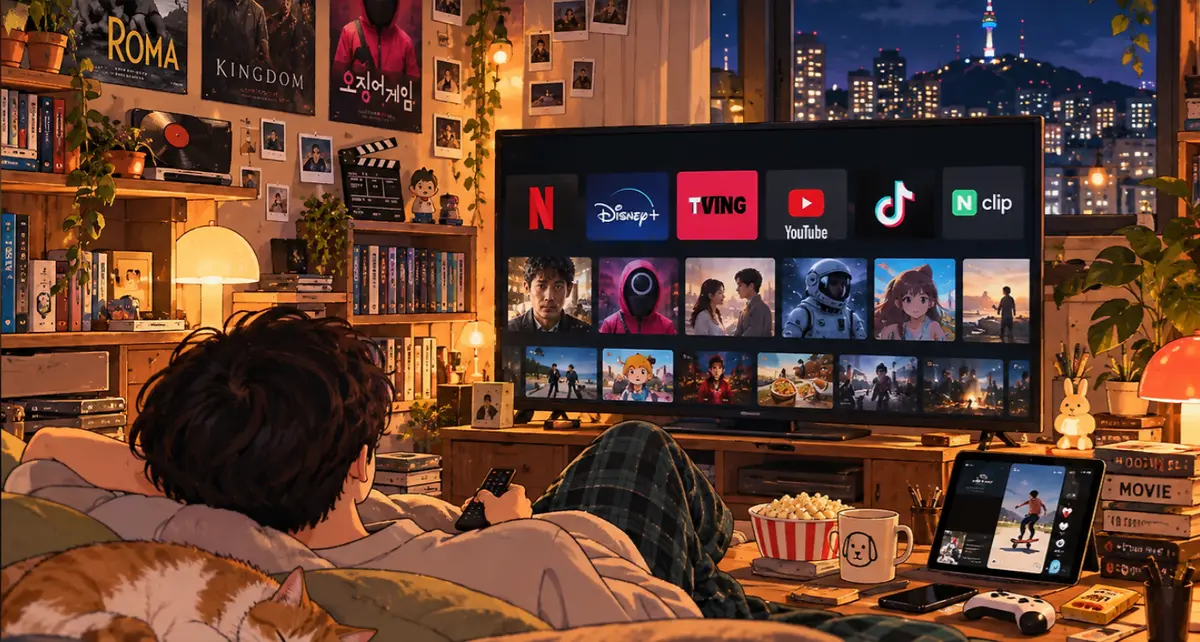
On Sept. 30, Naver TV — once Naver’s answer to YouTube — shut down. The timing was striking: 2026 marks 10 years since Netflix entered Korea. Naver is now betting on its short-form Clip service. Here is how video consumption in Korea has changed over the decade, and what it means for marketers.
A decade that broke the TV schedule
Viewing used to follow a fixed sequence: theaters first, DVD later, then a holiday broadcast on TV. Dramas meant sitting down at a set time. Netflix broke that model — watch when you want, binge as much as you want. Streaming films now compete for Oscars as a matter of course.
In Korea, Netflix became both a gateway for global content and a channel for Korean content to reach the world, from Kingdom to Squid Game. That success also raised concerns about Korean IP being tied to a global platform and a production ecosystem heavily dependent on it.
Netflix and cinemas by the numbers
- Netflix monthly active users in Korea: about 15.5 million, roughly 30% of the population (WiseApp·Retail)
- Netflix’s share of usage time among major OTT apps: about 58%
- 2025 cinema attendance: about 106 million, down roughly 14% from about 123 million a year earlier
- First-half 2026 cinema attendance: about 57 million, up more than 34% year over year
Two films crossed 10 million admissions in 2026: Jang Hang-jun’s Wang-gwa Saneun Namja drew 16.92 million to become the second-highest-grossing Korean film ever, and Christopher Nolan’s The Odyssey also passed 10 million. Audiences are getting pickier about what they see in theaters. Director Lee Chang-dong’s Venice prize winner Possible Love opened in cinemas on Sept. 23 and arrives on Netflix on Nov. 6 — a theater-first, streaming-second path. Meanwhile, Netflix itself now faces pressure from YouTube.
What content marketers should take from this
The question is no longer “theater or streaming,” but how to reach more people.
- Assign each channel a role. Theaters became the place for films worth seeing properly; every channel carries different expectations. Plan a premiere channel and amplification channels instead of posting the same video everywhere.
- Plan for platform risk. Platforms like Naver TV can disappear. Keep core content assets on owned channels too.
- Story outlasts format. Platforms and video lengths change; audiences still look for a good story.
For how YouTube is reshaping video discovery, see YouTube rolls out Ask YouTube AI search to all US users. For creator content moving onto the TV screen, read Vizio adds 40+ creator channels to WatchFree+.