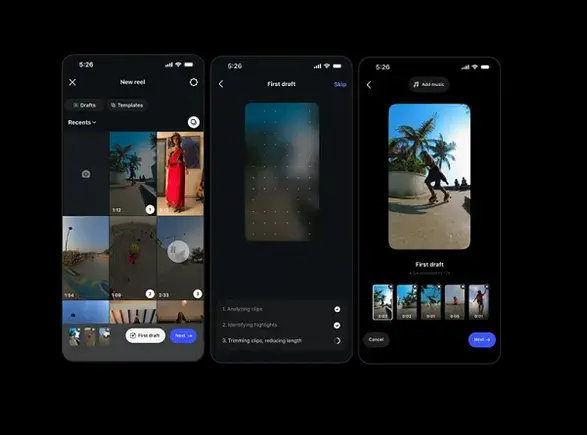
Instagram has launched First Draft, a feature that automates the first hurdle of Reels production. Select multiple clips from your gallery and it picks out the best parts of each, cuts the pauses, and assembles them into a single Reel draft. Instagram's pitch: "Simply select your clips, and with one tap, it cuts the pauses and trims down your clips, so you have a starting point to build from in seconds." Everything it does is reversible — reorder, adjust, or override anything before moving on. It's accessible from the Reels gallery or the Instagram camera.
Why a "draft," specifically
The target isn't editing skill — it's the barrier to starting. Footage piles up while creators stall on where to cut; Instagram explicitly frames the feature as cutting down "consternation and second-guessing." The machine handles the technical trimming so the human reaches the creative decisions sooner. With Reels consumption accounting for roughly 50% of all time spent on Instagram, the platform needs the production side of that equation as frictionless as the consumption side to keep supply flowing.
How to use it in practice
Clear the backlog of unedited footage
Most brand accounts sit on dormant clips — event coverage, product shoot behind-the-scenes, daily store life — shot but never edited. First Draft is most useful as inventory clearance: turning that backlog into reviewable drafts. The draft doesn't need to be publish-ready; existing in reviewable form removes a real bottleneck.
Read it alongside Meta's editing stack
Meta is layering production tools deliberately: First Draft makes starting points inside the app, while the standalone Edits app handles serious editing — and Edits is shipping features almost weekly, as we covered in Edits Adds Folder Management and Image-to-Video — Meta Ships Almost Weekly. A two-track workflow is now natural: light content finished in-app, invested content routed through Edits.
Our take: as production gets cheap, differentiation moves to planning and text
Draft automation raises the floor of content volume. When everyone can produce easily, producing well stops being the differentiator. Two variables remain: the planning that decides what to shoot, and the text that gets content surfaced by algorithms and search. Captions in particular are no longer decoration but data a search system reads — the subject of Instagram Published Its Caption Playbook — Captions Are Search Text Now. Where should the editing time First Draft saves go? Not into more video — into sharper planning and captions.