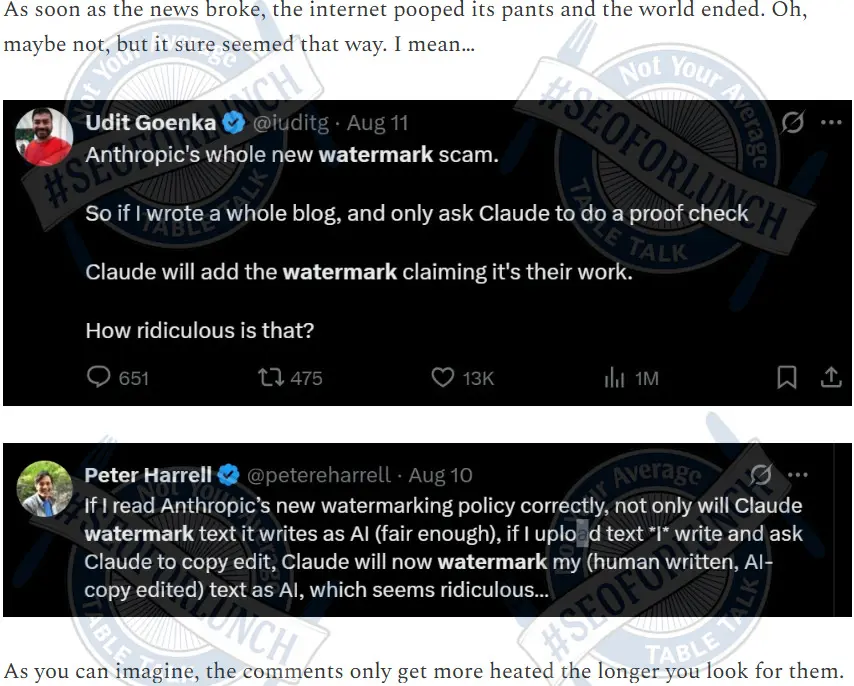
When Anthropic announced machine-readable watermarks for Claude-generated text, the SEO world flinched. Nick LeRoy's response in Search Engine Land cuts to the motive: what are you actually afraid of? That people will discover you're publishing junk — or that search engines will penalize you for using AI? The first is worth worrying about. The second is a misconception.
What a watermark can and can't say
A watermark reveals one thing: AI participated somewhere in the production process. It can't tell anyone who originated the idea, how much AI contributed, or whether the finished work is accurate or valuable. There's a massive difference between using AI to organize your thinking, challenge a draft, or tighten your prose — and blindly publishing its first response. The watermark doesn't distinguish between them. If being "found out" would embarrass you, the problem isn't the watermark; it's that you don't believe the work can withstand scrutiny. (Anti-watermark tools are already becoming a business — which tells you plenty about where some publishers' budgets are going.)
Google punishes valueless scale, not AI use
Google has never said AI-generated content is automatically penalized. Its own guidance acknowledges generative AI can be useful for researching topics and structuring original content. What Google targets is scaled content abuse — large volumes of low-value content created to manipulate rankings. That fight predates AI; AI just injected the spam with steroids. And enforcement is intensifying, as the volatility documented in Google's August 2026 Spam Update Hit 1.8x Harder Than Normal — 1 in 6 Top-10 URLs Fell Past Position 100 makes plain. AI content isn't the problem. Unoriginal content produced primarily to manipulate rankings is.
The same logic holds for answer engines. There is no rule that watermarked content gets excluded from AI-generated answers. The operative question isn't "can the model tell AI helped create this?" but "does this page contribute anything worth retrieving, citing, or synthesizing?" And the inverse is equally true: "a human wrote it" is no advantage when a thousand humans already wrote the same thing. That's the visibility principle we unpacked in Being Cited by AI and Being Recommended Are Different Problems — the Two Jobs of AI Visibility.
Watch outcomes, not AI scores
Substack now lets readers scan posts for AI likelihood via its Pangram integration. LeRoy scans his own post and shrugs at the result — 8%, 18%, 80%, it doesn't matter. "Eighteen percent AI" is a random number that says nothing about whether readers finished the piece, shared it, subscribed, clicked a sponsor, or hired the author. Attention, trust, subscribers, and revenue are the winning metrics. If the post produces those, it did its job; if it's useless, a "100% human" score won't rescue it.
The four-question test
The pre-publish standard isn't watermark presence. It's four questions: Is it accurate? Is it original enough to justify existing? Is it useful to its intended audience? Would you defend it with your name attached? Pass, then publish and stand behind it. Fail, and manipulating an AI score won't make it better. The rules never changed — garbage doesn't earn the right to scale, whoever or whatever wrote it.