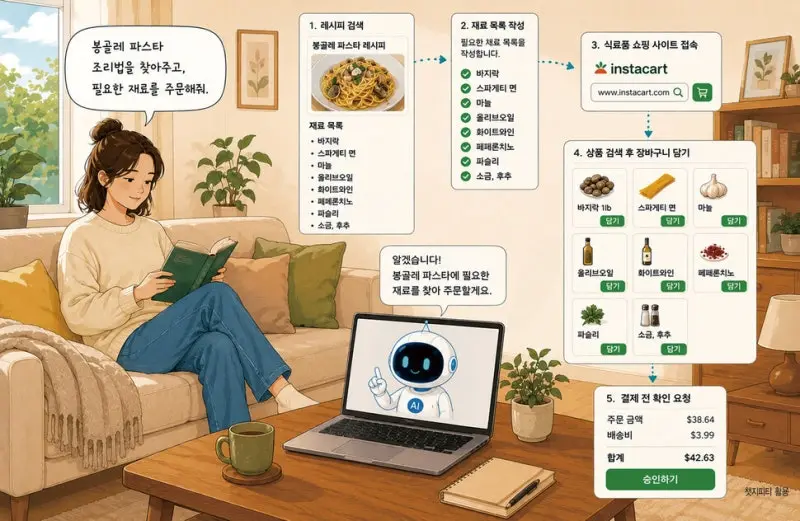
A user asks: "Order the ingredients for vongole pasta." The AI assistant finds a recipe, compiles the ingredient list, searches for those products on the US grocery delivery service Instacart, and adds them to a basket — operating without human intervention right up until it requests approval at the final payment step.
That is how the ChatGPT agent works. And it is giving new meaning to an old engineering term: headless.
An expanding definition
Headless originally described an architecture separating the UI from the backend — data and functionality served without a front end.
The concept has now expanded to describe AI assistants accessing service data directly on a user's behalf to handle shopping, bookings and similar tasks. The screen a human looks at — the head — disappears, and the AI occupies that position.
Salesforce adopting it as strategy
Salesforce is a leading example of treating this as business strategy. It is driving a transition so that customer record lookups and contract checks can happen through an assistant inside Slack.
The idea is that users never open Salesforce — they handle it conversationally in the Slack window already in front of them. Model Context Protocol (MCP) is presented as the enabling technology.
Platform resistance
Here is where the conflict sits. Platforms are resisting, worried about declining revenue from existing traffic and advertising.
Understandably so. If users never arrive at the site, there is nobody to serve ads to. The chance to raise basket size through recommendation algorithms disappears, along with the inventory for related-product placements. An AI assistant picks exactly what was asked for and nothing else.
Amazon plays both sides
Amazon's response captures the tension precisely. It blocks external assistants from accessing its products while operating its own "Buy for Me."
Doors closed to outside AI; the same capability offered in-house. The fight is not against headless commerce itself but over whose headless layer wins.
Industry consensus is that platform competitiveness will ultimately rest on data ownership and the ability to collaborate.
What marketers should prepare
Make product data machine-readable. What an AI assistant selects on is structured data, not the detail page a human reads. This pattern is already visible across AI shopping — see AI Shopping Starts With Your Product Feed, Not Your Product Page.
Quantify how much revenue depends on ad exposure. In a scenario where site visits themselves decline, calculating how exposed your onsite advertising and recommendation revenue is constitutes basic risk management.
Decide your access policy. Open your data to external AI assistants, or close it? For businesses without Amazon's leverage to close the door, opening early to secure visibility may be the more realistic play.
Calibrate expectations. Deploying agents does not translate directly into results. For the structural reasons pilots stall, see Four Myths About AI Agents: Why 88% of Pilots Never Reach Production.
The competition is shifting from building the best screen to being chosen without one.