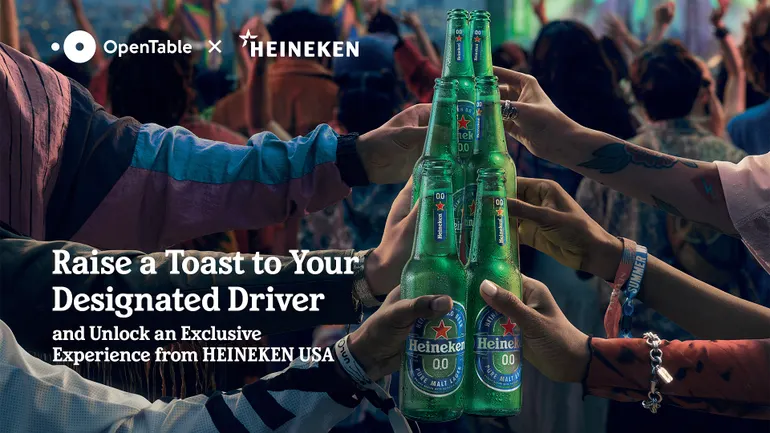
Heineken is partnering with OpenTable on a pilot program that rewards designated drivers, aiming to promote safe driving habits while building its non-alcoholic product, Heineken 0.0.
The interesting part is the method. Rather than buying media to argue the case, the brand intervened at the screen where the decision actually gets made.
How the program works
Designated drivers appointed while booking at 10 participating restaurants in Houston through a dedicated landing page unlock rewards — including rideshare vouchers for future nights out and free Heineken 0.0.
The pilot runs on weekends from July 31 to Oct. 4. Participants can appoint a designated driver after completing a pre-experience survey. Selected individuals who complete the post-experience survey receive a $100 SafeRides.org voucher or a $25 gift card to buy Heineken 0.0 for an upcoming night out.
Building surveys into the experience gives both Heineken and OpenTable consumer insight. The campaign doubles as a research instrument.
The numbers behind the idea
The pilot grew out of Heineken's own research:
- 71% of Americans would be more likely to make a safe ride home plan if prompted at the time of booking a restaurant reservation
- 57% say a safe ride home or designated driver plan is not something they consider when making reservations
- 82% say having a safe ride home plan lets them enjoy the night more
Line those three up and the strategy explains itself. People know the plan has value (82%), do not think about it while booking (57%), and change behaviour when asked at that moment (71%).
The bet is that the gap between attitude and behaviour closes with timing, not persuasion.
The social context for the category
More than half of Americans view the designated driver as the "hero" of the night, per Heineken's research. The brand wants to attach a reward to that role.
It also wants to further normalise ordering and drinking non-alcoholic beer. 49% of U.S. consumers say non-alcoholic beer makes them feel more included in social moments when they are not drinking alcohol.
Market backdrop
The U.S. non-alcoholic beer market grew 23% in 2025 and continues to surge. Per Beer Institute data, beer makes up 87% of all non-alcoholic beverages, and 61% of consumers say they would consider a non-alcoholic beer that tastes like their favourite.
The category is benefiting from Americans drinking less overall as understanding of alcohol's health impact grows.
Competition is intensifying accordingly. Athletic Brewing Company announced its first MLB athlete partnership in May and expects to increase national media spending 120% compared with three years ago. Tom Holland's Bero announced a July effort with fitness chain Barry's to reach fitness-minded consumers.
Despite a net revenue decline in the United States, Heineken 0.0 saw double-digit volume growth in 20 markets, according to the company's 2025 full year report.
What marketers should take from it
Relocate the intervention point. Heineken did not buy media; it acquired placement inside a booking flow. Showing up where the behaviour is actually decided can outperform repeating the same message in advertising.
Partnerships are inventory acquisition. For OpenTable this is a media product; for Heineken it is context that cannot be bought as an ad. Reece Jones, general manager for OpenTable Media, framed it as "a new way to bring awareness for responsible consumption into the reservation process."
Instrument the pilot. The pre/post survey structure produces both campaign measurement and the evidence base for the next program. For another example of an experiential brand program scaling city by city, see Tinder Expands Events to Nine More Cities: From One-on-One Dates to Shared Experiences.
Heineken collected its safe-driving data in two online surveys: a general U.S. survey of 1,000 respondents aged 21 and older conducted April 2–12, and a Houston-specific survey conducted April 3–13.