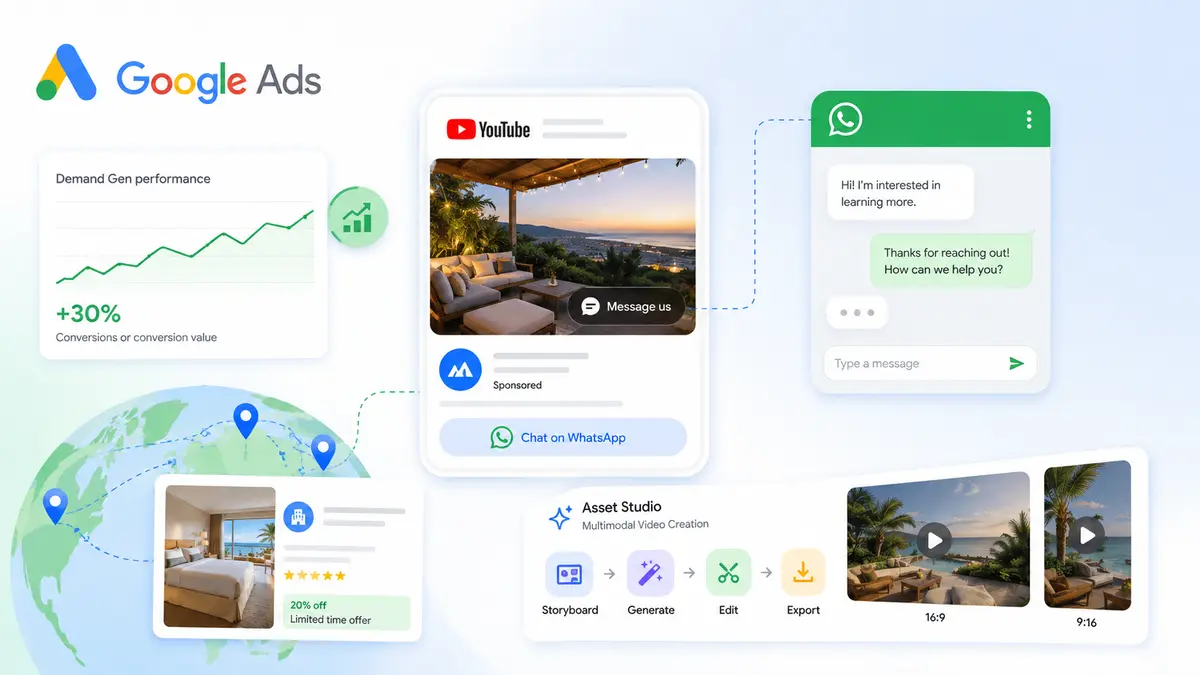
Google announced its August Demand Gen Drop, a three-part update spanning messaging, travel, and AI-powered creative. The company says the hundreds of improvements it shipped to Demand Gen in the second half of 2025 are already driving a 30% average increase in conversions or conversion value — and the new features push the campaign type further toward measurable customer acquisition.
What's new in Demand Gen
Start a conversation straight from a YouTube ad
The headline test lets people open a conversation with a brand through messaging apps directly from Demand Gen ads on YouTube. A high-intent viewer who discovers a brand in a video ad can move straight into a chat instead of navigating a website or landing page. For lead generation advertisers, that is a new action type beyond the click-through — one designed to shorten the path from discovery to contact.
Travel advertising gets more personal
Demand Gen is expanding for travel advertisers specifically. Ads will be able to surface local activities, events, and real-time offers, while hotel ads become more personalized so relevant properties reach the audiences Google considers the best fit. The goal is connecting discovery-stage advertising with offers travelers might actually book.
AI video creation is generally available
Multimodal Video Creation in Asset Studio has reached general availability. Advertisers can move from storyboarding to producing horizontal and vertical video assets in a single workflow — a meaningful cost reduction for the biggest bottleneck in scaling Demand Gen: producing enough creative for every format the inventory demands.
Why it matters
The direction is unmistakable: Google wants Demand Gen judged as an acquisition channel, not an awareness play. Messaging collapses the funnel for high-intent prospects, and GA-status AI video removes the production excuse for thin creative coverage.
The caveat is control. As automation deepens, Google has been handing back selective levers elsewhere — see Performance Max Is Testing Channel Prioritization Controls — the First Direct Lever Into the Black Box — and adding verification surfaces for AI-generated assets, like the reporting covered in Google AI Is Rewriting Your Shopping Ad Titles — a New Product Titles Report Shows What It Serves. Treat the new Demand Gen features the same way: pilot the messaging path only with a staffed response workflow behind it, and put a brand-fit review step between AI video output and live campaigns.