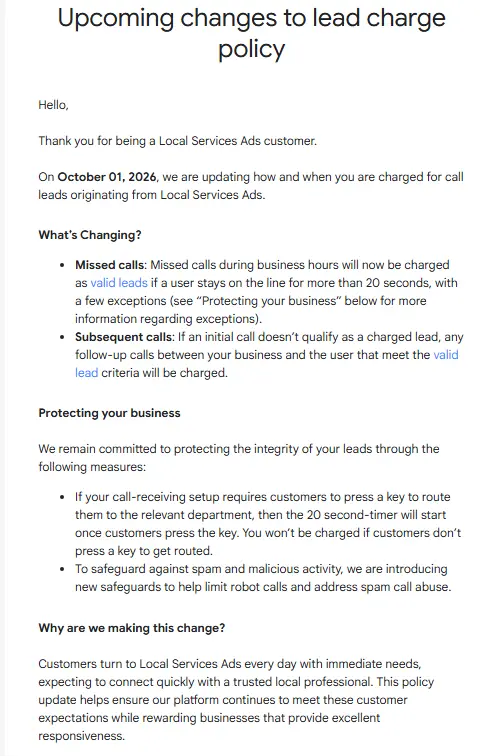
Google is updating its Local Services Ads lead charge policy, changing how and when advertisers are charged for calls generated by their ads. Starting Oct. 1, certain missed calls and subsequent calls that meet Google's valid lead criteria become chargeable — meaning you could pay for a call nobody at the business actually answered.
What changes: 20 seconds during business hours
The core change is one line. Missed calls during business hours will be charged as valid leads when a user stays on the line for more than 20 seconds, with some exceptions.
Until now, advertisers largely paid for connected calls. The threshold now includes how long the caller waited, not whether anyone picked up. If your team missed the call but the caller held for 20 seconds, that can count.
Follow-up calls count too
If an initial call does not qualify as a charged lead, Google says subsequent follow-up calls between the business and the user will be charged if they meet its valid lead criteria.
So a missed first call is not a free lead. Reconnect later, and the charge lands there instead.
The call routing exception
Google is introducing an exception for businesses whose call-receiving setup requires customers to press a key to reach the appropriate department. In those cases, the 20-second timer does not begin until the customer presses the key. Businesses will not be charged if the customer never presses a key and is therefore never routed.
For anyone running an IVR or departmental menu, this exception has real cost implications. A caller who abandons before pressing a key does not generate a charge.
Spam protections, details unstated
Google says it is introducing new safeguards intended to limit robot calls and address spam call abuse as part of the change. The announcement does not provide further detail on how those protections work.
Once missed calls become billable, spam handling stops being a nice-to-have and becomes a precondition of the policy. With the mechanism undisclosed, advertisers should watch their own lead reports for anomalous patterns during the first weeks.
Google's stated reasoning
Google says Local Services Ads customers often have immediate needs and expect to connect quickly with a trusted local professional. The company frames the policy change as helping the platform meet those expectations while rewarding businesses that provide "excellent responsiveness."
What to fix before Oct. 1
The change puts far more weight on your ability to answer calls during business hours. Once missed calls longer than 20 seconds cost money, call responsiveness and routing setup connect directly to LSA cost.
Audit these:
- Business hours accuracy. Any hours registered as open when nobody can actually answer now convert missed calls straight into spend.
- Concurrent call capacity. If a single line handles inbound, a second caller during an active call rolls to missed.
- IVR prompt length. With key-press routing, the timer starts at the key press, so a shorter prompt that gets callers through helps both answer rate and cost.
- Callback process for missed calls. Since follow-up calls are chargeable, a business with no callback workflow pays for the lead and captures none of the value.
Meanwhile the booking path on LSAs is widening in the same window. Read alongside Google Opens Local Services Ads Direct Booking to 500+ Partners — lead volume grows on both the call and booking sides, which makes absorbing after-hours demand through booking a cost-management move as much as a convenience one.
For the broader migration context, see Google Expands Local Services Ads Categories.
Bottom line: from Oct. 1, Google broadens what qualifies as a charged Local Services Ads call lead, including missed calls over 20 seconds during business hours and qualifying subsequent calls. This is an operations problem before it is a media problem.