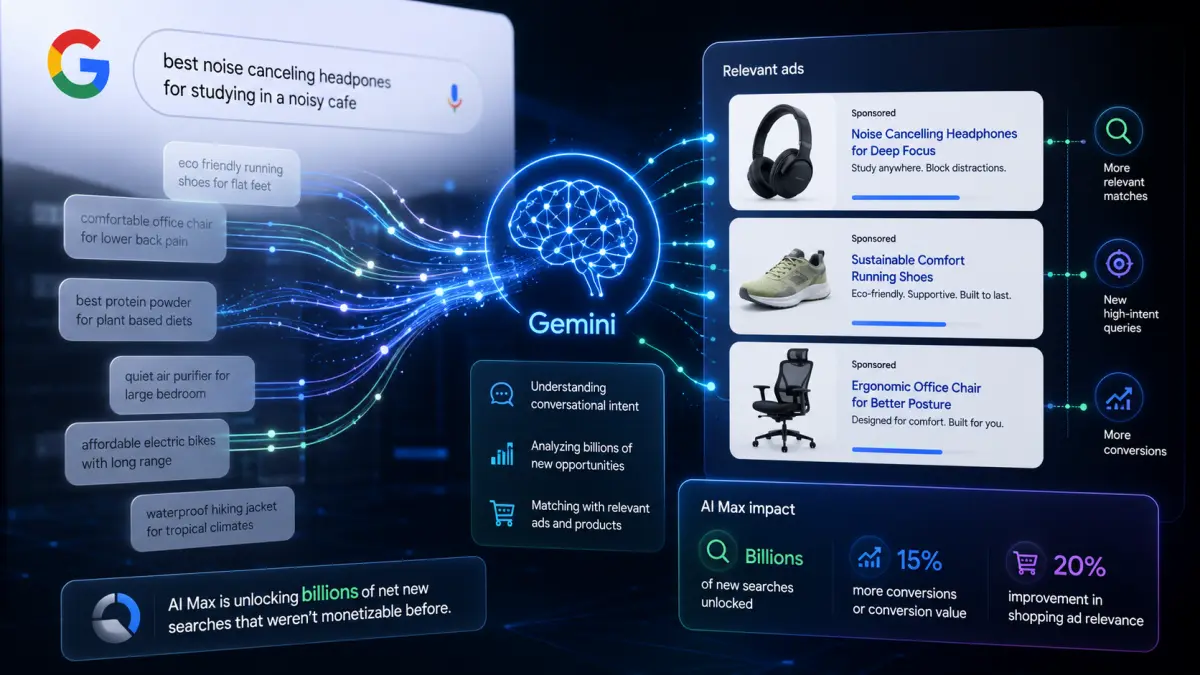
Google said AI Max is opening "billions" of previously unmonetized searches to ads, giving Alphabet a clearer path to expand Search revenue as queries become longer and more conversational.
During Alphabet's Q2 2026 earnings call, Google SVP and Chief Business Officer Philipp Schindler said AI Max is helping the company match ads to searches that were too complex or ambiguous for traditional keyword targeting.
AI Max leaves beta
| Item | Figure |
|---|
| AI Max status | Out of beta |
| Advertisers adopted | More than 500,000 |
| Average lift using AI Max or PMax | 15% in conversions or conversion value at a similar ROAS |
Gemini improves ad matching
Google said Gemini has improved the relevance of Shopping ads for complex queries by about 20%.
Gemini can better understand longer, conversational searches, interpret commercial intent, and match those searches with relevant ads.
That is helping Google turn more searches into ad opportunities without relying only on exact keyword matches.
Why we care
Google is using AI to expand the number of searches that can carry ads, not just improve existing campaigns.
That could create new traffic opportunities, but it also gives advertisers less visibility into how queries are matched.
AI Mode ads take shape
Google shared new details on how it plans to monetize AI-powered Search experiences:
- Highlighted Answers: an AI Mode ad format that places clearly labeled sponsored links inside AI-generated list responses. Google said the format is already showing early user traction
- Contextual sitelinks generated from conversations
- Direct Offers, which surface promotions during planning journeys. IHG Hotels & Resorts was named as an upcoming partner
Search ads stretch beyond keywords
The announcements show how Google is building ad products around intent, not just keywords.
As Gemini handles more complex searches, advertiser performance may depend more on product feeds, creative assets and landing pages that give Google enough signals to match ads to user needs.
Bottom line
Google's clearest message from the call was that AI Max is not just a campaign feature. It is becoming a way for Google to create more ad inventory inside Search.
Practical takeaways
Check the conditions on that "15% lift." Google's figure is conversions or conversion value at a similar ROAS — volume growth, not efficiency gain. Separate out whether budget rose alongside it.
Assume new inventory means new spend. "Billions of new monetizable searches" also means more surface to compete on. The same budget may not hold the same position.
Design reporting around lost matching visibility. As query matching gets more opaque, after-the-fact control via search term reports gets harder. Build negative keyword policy up in advance.
Reclassify feeds and landing pages as ad creative. As the article states, performance depends on the signals you give Google, not the keywords you pick — practical guidance in AI Shopping Starts With Your Product Feed.
Validate auto-created assets separately. How AI Max's generated copy actually performs was tested across three accounts in Testing Google Ads AI Max's Automated Ad Copy — results diverged sharply by business type.
Read it against Alphabet's revenue narrative. The same quarter's structure is covered in Google's Ad Revenue Hits $81.6B. AI Max is the concrete mechanism behind the claim that AI is additive to search.