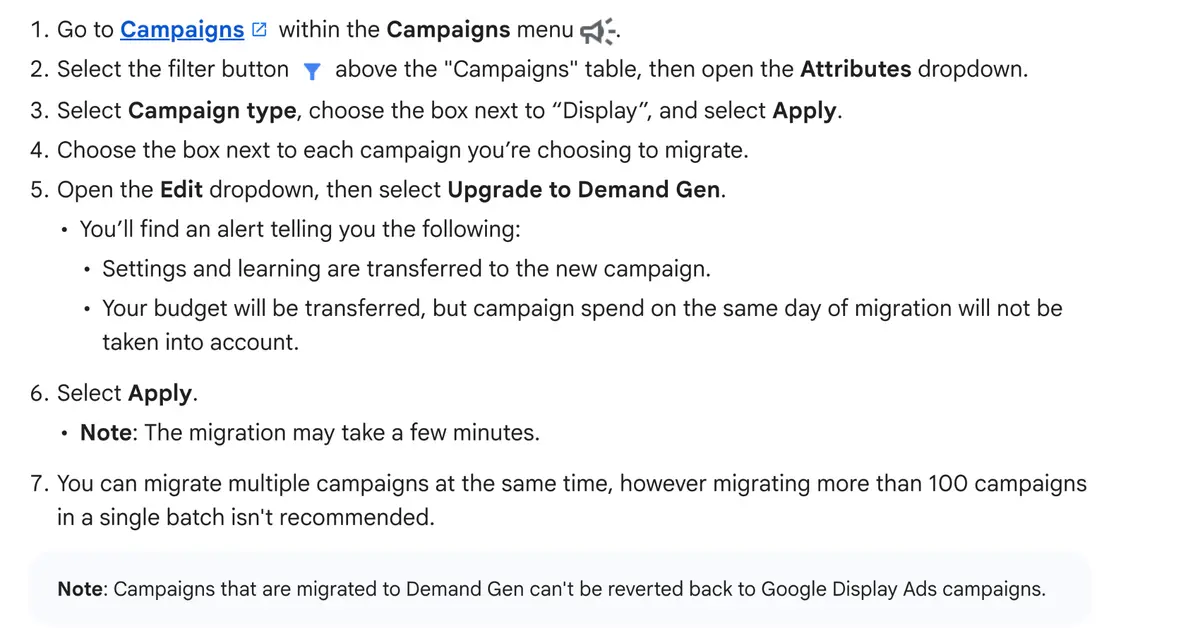
Google has made it official: standalone Display campaigns are heading the way of Smart Shopping, Discovery, and Local campaigns — into Demand Gen. After the May announcement, a migration tool began appearing in accounts in June. In January 2027, creating new standalone Display campaigns will be permanently disabled, with auto-migration expected later in 2027 on an unspecified date. Writing in Search Engine Land, ZATO's Sarah Vlietstra mapped what actually changes.
What changes in the migration
What you lose: the manual controls
The migration tool converts live campaigns while keeping the last 42 days of performance history, minimizing the new campaign's learning period. Migrated campaigns start as Google Display Network-only Demand Gen; other channels can be added afterward. The bigger issue is what's unsupported. Demand Gen's bid strategies are Target CPA, Target ROAS, and Maximize Clicks — so Manual CPC, Viewable Impressions, and Pay for Conversions users must switch. Bid adjustments, seasonality adjustments, and portfolio bidding aren't supported. Neither are Business Data feeds, uploaded HTML5 ads, or third-party ads — though Google says the latter two are planned for late 2026. Two operational notes: budget already spent on migration day isn't carried into the new campaign, and Google warns performance may fluctuate post-migration.
What you gain: new inventory and new optimization
In exchange, Demand Gen brings Discover network and Google Maps inventory, formats unique to the campaign type, and generative image tools. Recent changes matter too. Since March, Lookalike Audiences shifted from strict targeting to "audience suggestions" — your seed list becomes a signal Google's models can reach beyond, and new segments take up to 96 hours to populate. April's view-through-conversion optimization bids toward users who see a YouTube or Discover ad, don't click, but convert later — meaningful for accounts too conversion-starved for conversion-based bidding. One catch from July: Demand Gen campaigns on Discover using view-through optimization move from CPC to CPM billing.
How to prepare
Timing is the decision that matters. Rather than waiting for auto-migration, migrate deliberately before Q4 so the fluctuation window lands outside peak season. Build seed audiences for Lookalikes early (remember the 96-hour lag), and if your operation leans on seasonality adjustments or portfolio bidding, design replacements now. This is less a campaign-type swap than a strategy shift — from granular manual control to automated media buying.
Two companion reads frame the landscape you're migrating into. The features waiting on the other side are covered in Google's August Demand Gen Drop — Messaging Ads, Travel Tools, and AI Video Goes GA. And the more automated the buying, the bigger the trap of metrics that merely look efficient — especially where CPM billing meets view-through optimization. Keep the discipline from When Cheap Clicks Look Like Efficiency — Paid Media Optimization Working Against You: validate incremental results separately.