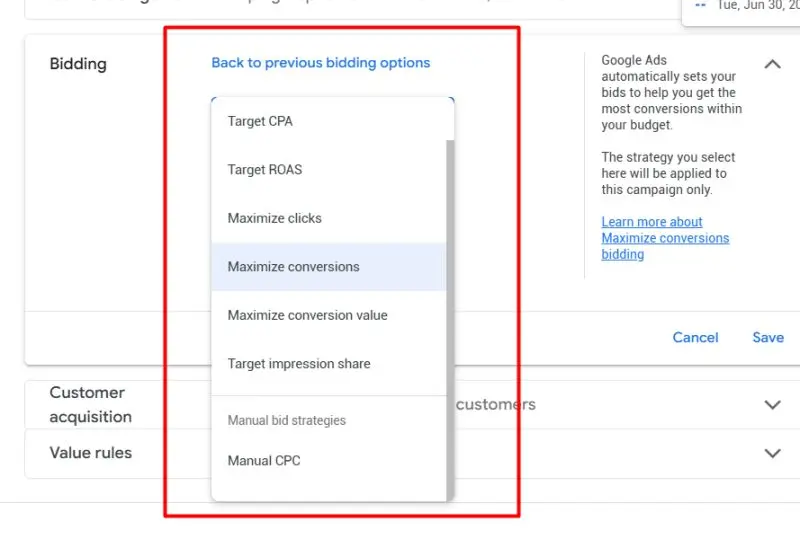
Google appears to be changing how Smart Bidding strategies are presented during campaign setup, surfacing Target CPA and Target ROAS as standalone bidding strategies instead of optional targets within Maximize Conversions and Maximize Conversion Value.
While the change doesn't appear to alter how the bidding strategies function, it could make campaign setup more intuitive for advertisers.
What's happening
Advertisers have started spotting a revised bidding strategy selection menu in Google Ads. In affected accounts, Target CPA and Target ROAS now appear as dedicated bidding strategy options alongside:
| Bidding strategy |
|---|
| Maximize Clicks |
| Maximize Conversions |
| Maximize Conversion Value |
| Target Impression Share |
| Manual CPC |
Previously, advertisers typically selected Maximize Conversions or Maximize Conversion Value before optionally applying a Target CPA or Target ROAS goal. The updated interface makes those strategies more prominent during campaign creation.
Why we care
Even seemingly small interface changes can influence how advertisers configure campaigns.
Presenting Target CPA and Target ROAS as standalone options makes it clearer that they're distinct bidding approaches rather than secondary settings.
It may be groundwork for August 17
The change may be laying the groundwork for upcoming Google Ads updates.
Google Ads trainer Charlotte Osborne suggested the revised layout could be related to changes scheduled for 17 August, making it clearer for advertisers who want to switch between Target CPA/Target ROAS and Maximize Conversions or Maximize Conversion Value.
Bottom line
Google appears to be simplifying Smart Bidding selection by giving Target CPA and Target ROAS greater visibility during campaign setup.
Whether it's a permanent redesign or preparation for August's bidding updates, it's another sign that Google continues to refine how advertisers interact with its automated bidding tools.
First spotted by Google Ads expert Natasha Kaurra, who shared the view on LinkedIn.
Practical takeaways
Confirm first that this is presentation, not function. Behaviour is unchanged, so existing campaigns need no action — if performance moved, look elsewhere for the cause.
But selection behaviour can still shift. That is the article's point: what appears first in the UI influences what gets chosen. Any internal campaign-creation guide or onboarding document needs updated screenshots and step descriptions.
Put August 17 on the calendar. It is a trainer's inference, but if bidding strategy switching changes are coming, documenting your current strategy configuration beforehand gives you a baseline for telling what actually changed.
Manage them distinctly from unconstrained maximisation. Target CPA/ROAS are constrained optimisation, while Maximize Conversions and Conversion Value spend toward the budget. Placing them side by side is the more accurate representation — and a good moment to re-confirm internally that running maximisation without a target is a different strategy from setting one.
Budget for the learning period when switching. Easier switching in the UI does not remove the fact that changing bidding strategy restarts learning. Improved accessibility also increases the temptation to change too often.
Read it with the widening set of objectives. Retention arriving as a formal campaign goal is covered in Google Ads Editor 2.13 and Google Ads API v25. Google keeps expanding the menu of what you can optimise toward.
Treat it as a sighting. It is an observation, not an announcement — absence from your account is normal and the spec may change during rollout.