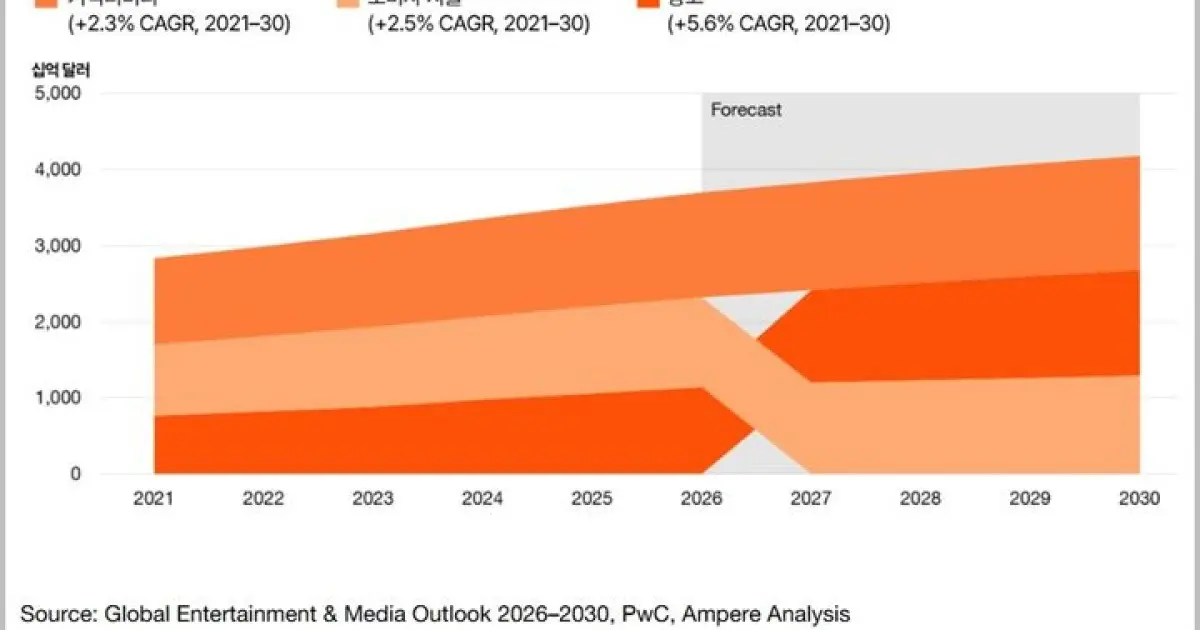
The global entertainment and media (E&M) market is projected to grow at 3.4% annually to reach $4.2 trillion by 2030, according to Samil PwC's Global Entertainment and Media Outlook report.
Korea grows 3.0%, ranking ninth
Korea's E&M market is forecast to grow at 3.0% annually over the same period, establishing it as the world's ninth-largest market by 2030.
That trails the global average of 3.4% — a notable projection at a moment when Korean content exports dominate the international conversation. Market size growth and industry competitiveness do not necessarily move together.
The report assesses that Korea faces rapid structural change driven by AI and data, retail media, ad-supported pricing tiers, and OTT competition.
Advertising accounts for $1.4 trillion
Of the $4.2 trillion total, advertising represents roughly $1.4 trillion — about a third of the entire market.
The report identifies two primary growth engines:
- Ad-supported OTT
- Retail media
Both share a structural characteristic: they push advertising back into media consumption that had moved away from it. That aligns with rising subscription fatigue and price resistance making consumers more willing to tolerate ads — a shift covered in Consumers Are Warming to Ads: 69% Would Choose Ads to Save Money.
What determines competitiveness
The report names two determinants of future competitiveness:
- Data and AI capability
- Securing differentiated IP — and the ability to monetise it
The word doing the work is "monetise." Owning IP and earning from it are different problems, and the report makes the second an explicit condition rather than an assumed consequence.
What marketers should take from it
The character of available inventory is changing. If ad-supported OTT and retail media are the growth engines, the inventory expanding fastest is mid-viewing exposure and point-of-purchase exposure. Two fundamentally different placements growing simultaneously means the media mix has to split accordingly.
Formalise retail media as a media line item. In many organisations retail media still sits inside the commerce team's trade promotion budget. Named as a market growth engine, it needs to be evaluated against other channels inside the media plan.
Use Korea's 3.0% figure to calibrate expectations. A market growing at 3% a year means growth largely requires taking share. Competitive displacement strategy outweighs category expansion.
Design the IP monetisation path in advance. The capability to create content and the structure that turns it into recurring revenue are separate builds. For how streaming platforms are now colliding across creators, advertising and TV, see Netflix vs YouTube: The Streaming Rivalry Now Collides Head-On.