Cheaper clicks, better engagement
WordStream by LocaliQ analyzed nearly 1,800 Facebook ad campaigns across industries for its 2026 benchmarks, covering click-through rate, cost per click, conversion rate and cost per lead for traffic and lead campaigns. The headline: advertisers are getting more engagement for less money. Here are the key Facebook ad benchmarks.
Traffic campaigns
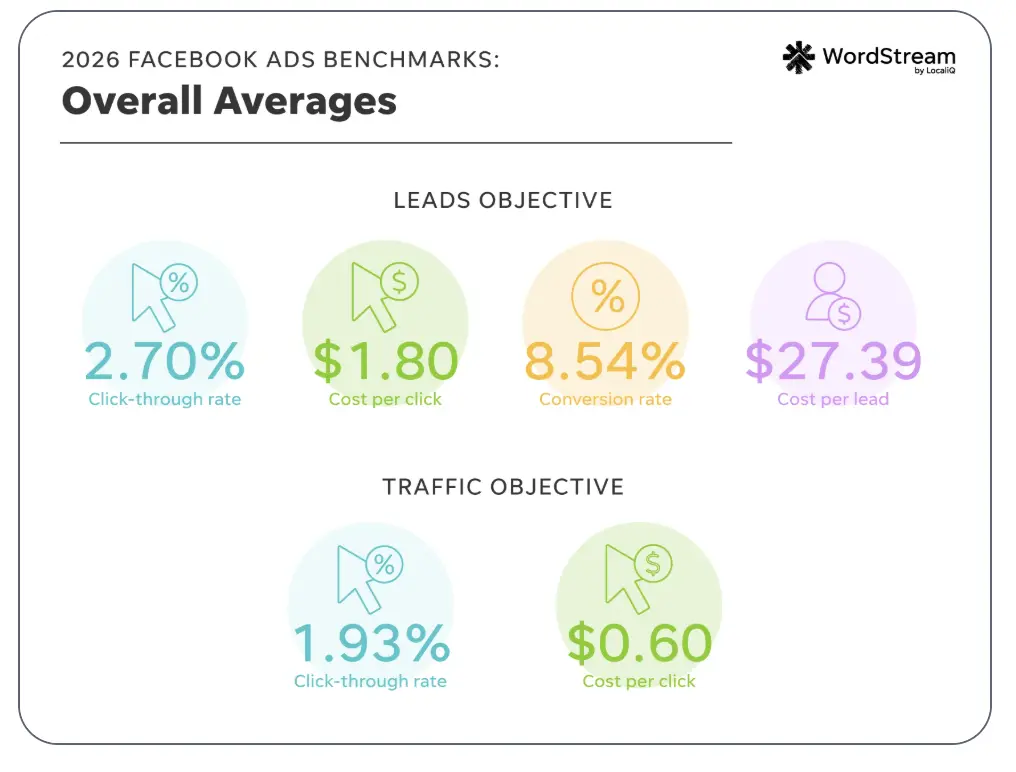
- Average CTR: 1.93% (up 12.87% year over year)
- Average CPC: $0.60 (down 14.29%)
Only two industries saw traffic CPCs rise: Shopping, Collectibles and Gifts (+73.53%) and Sports and Recreation (+43.90%). Real Estate fell the most (-39.56%), followed by Restaurants and Food (-37.50%) and Industrial and Commercial (-37.21%).
Lead campaigns
- Average CTR: 2.70% (up 4.25%)
- Average CPC: $1.80 (down 6.25%)
- Average CVR: 8.54%
- Average CPL: $27.39 (down 0.98%)
Most industries saw cheaper lead-campaign clicks: Automotive – For Sale (-44.17%), Dentists and Dental Services (-41.72%) and Health and Fitness (-30.30%). Only Education and Instruction (+4.24%) and Sports and Recreation (+0.93%) rose.
CPL varies widely
- Lowest CPL: Career and Employment $12.30, Real Estate $13.74, Arts and Entertainment $14.59.
- Highest CPL: Dentists and Dental Services $61.56, Beauty and Personal Care $50.91, Home and Home Improvement $42.95.
Why it matters
Traffic clicks got 14% cheaper while CTR rose nearly 13%, and lead campaigns got cheaper clicks with average CPL essentially flat. WordStream notes Google Ads CPC is now more than double Meta’s average CPC, though Google Search typically captures stronger purchase intent. It suggests improvements in Meta’s bidding and campaign optimization may be driving better conversion performance and lower costs.
How advertisers can use it
Benchmark against your industry
Industry numbers matter more than averages. High-CPL categories like dental and beauty should track lead quality and downstream conversions; categories with rising CPCs, like shopping and gifts, should revisit creative and targeting. These figures reflect WordStream’s dataset in U.S. dollars, so costs may differ in other markets.
Balance search and social
On cost per click, Meta looks cheaper, but search carries stronger intent — and search often harvests demand social created. Measure contribution across channels; see three ways to reclaim credit search took from paid social.
Manage creative as automation gets cheaper
As Meta’s optimization improves efficiency, creative diversity increasingly decides results. The problem of similar ads being treated as one is covered in your ten Meta ads might be one ad.