Tech/AI모비인사이드
OpenAI DevDay 2026 Recap — ChatGPT Becomes a Shared Workspace for People and Agents
OpenAI DevDay 2026 introduced the always-on agent Dots, GPT-6.1 Sol and ChatGPT Spaces. A recap of the shift from model races to work platforms.
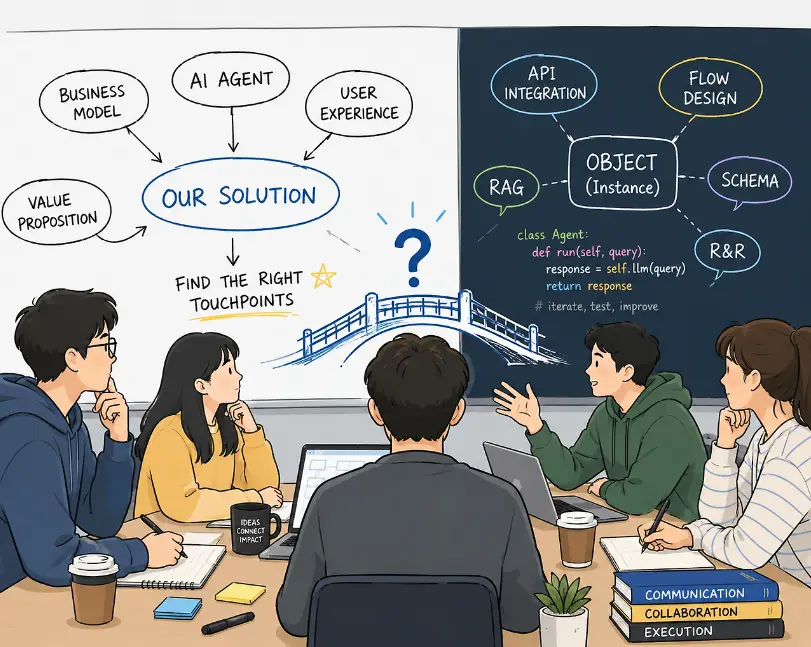
A meeting with an AI startup: founder, engineers and product managers around one table, working through business models and specific builds like agents. Once the plan takes shape, the conversation moves to splitting responsibilities and structuring development milestones.
The difficulty starts when engineering issues enter in earnest. In Korean tech circles this dialect has a name — "Pangyo accent" — too Korean to be English, too English to be Korean. Everyone nods. The team lead leans over: "Are you following this?" "Sort of. Mostly."
"Could you email us what we covered today?" "Sure, we'll start with the PRD and the SoW and send them over."
No. Fluent English does not decode engineering terminology, and learning to code does not deliver English.
The problem is overloaded words. "Right" means correct, entitlement and a direction. "Object" means a physical thing, a target, and a programming construct — and in a dev meeting it arrives untranslated: "every instance is an object."
The same collision happens within a single language. Asked "what's your address?" you start reciting a street address, and get corrected: "no, the site address." Python, for its part, uses "object address" too.
Words wear different clothes depending on the situation. Catch the context and the conversation works even when a term is unfamiliar. Knowing what this word points at right now beats knowing its full definition — which is exactly why experience compounds here.
The textbook SMCRE model — sender, message, channel, receiver, effect — is tidy, but no working meeting has room to inspect each stage. Try it and the meeting drags and decisions slip.
The usable tool is the clarifying question: "So on this point, we're taking the approach you described, correct?" One sentence that translates what was said back to the room. It costs far less than the rework produced by two people interpreting a spec differently. On designing meetings that actually reach a decision, see Structure Your Meetings in Four Acts.
This dialect is not going away, because inside the field it genuinely transmits faster and more precisely. The catch is that a language built for efficiency becomes a barrier for someone else. Convenience and exclusion sit at the same table.
One thing has gotten easier: instead of searching term by term, you can ask a generative model directly, which makes pre-meeting prep cheap. But the real fix is not individual prep — it is team-level alignment. If every new hire hits the same wall, that is an onboarding design problem, not a personal learning problem. A related failure mode — trying to hire capability a team has not defined — appears in They Tried Hiring 'AI Product Builders' and Failed.
No. The same word carries different meanings by context, so reading what a term points at in this specific discussion is more useful than knowing its dictionary definition.
Ask. Restating the point — "so we're handling this part this way, right?" — costs one sentence and prevents the rework that follows two people reading a spec differently.
If every new joiner hits the same barrier, treat it as onboarding design. Documenting the frequently used acronyms and artifact types (PRD, SoW and so on) in a team doc is the starting point.
To apply what you just read to your own site, start with a free audit of where things are now.
A strategist replies within 24 hours on business days.
OpenAI DevDay 2026 introduced the always-on agent Dots, GPT-6.1 Sol and ChatGPT Spaces. A recap of the shift from model races to work platforms.

Zero-click GEO explained from TBWA's observations: 68% of U.S. Google searches end without a click, so extend existing SEO content into AI citations.
Claude Fable 5.1 improves coding and research while cutting cache costs, reducing false safety interventions, and introducing regulatory watermarking.