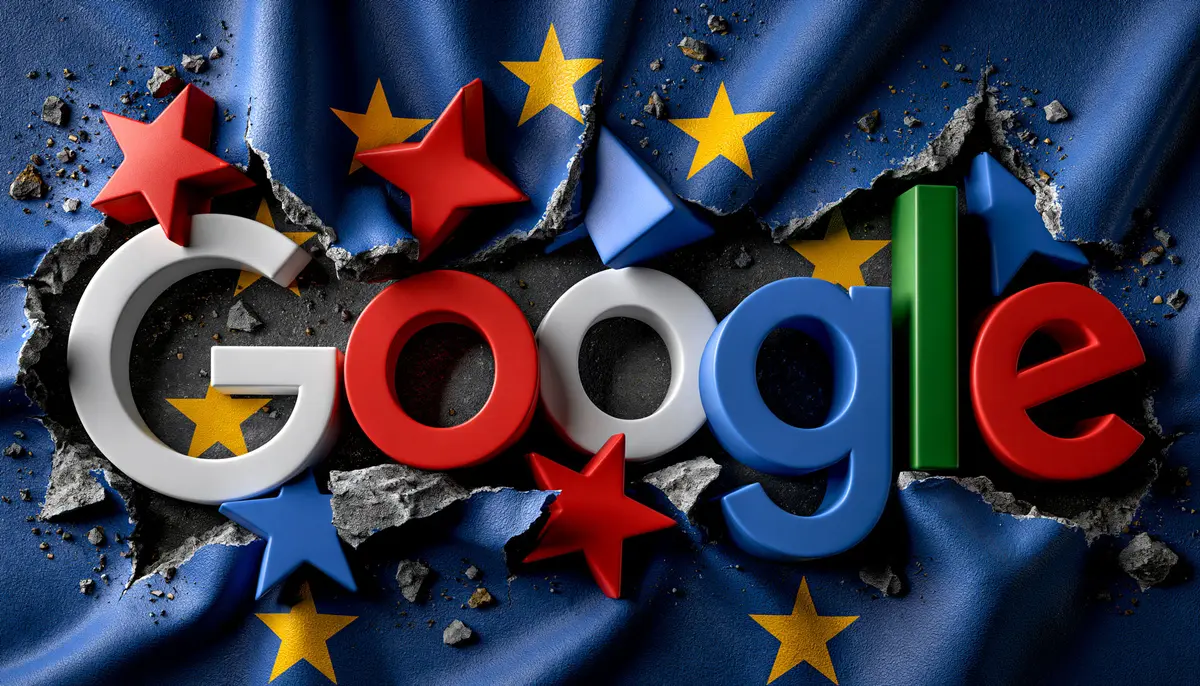
The European Commission announced two fines under the Digital Markets Act (DMA) against Google — one for Google Search and one for Google Play.
The total comes to €890 million, just over $1 billion.
| Target | Fine |
|---|
| Google Search (self-preferencing) | €460 million |
| Google Play (steering restrictions) | €430 million |
| Total | €890 million (~$1 billion) |
Google Search: self-preferencing
The Commission wrote:
"The Commission found that Google gives preferential treatment to its own services, including shopping, hotels, transport and sports results, over those of third parties in Google Search, thereby breaching its obligations under the DMA."
"Google displays its own services more prominently in search results, including at the top of the search results page or by using enhanced visuals and filters, while similar third-party services do not have the same prominence."
Google is required to:
"Treat third-party services that feature on Google's search results in a fair and non-discriminatory manner by reference to its own services."
Google Play: steering restrictions
"The Commission found that Google failed to comply with that obligation."
"In particular, Google prevents app developers from freely communicating and promoting offers and concluding contracts with users in distribution channels of their choice, including third-party app stores."
"While Google can receive a fee for facilitating the initial acquisition of a new customer by an app developer via Google Play, the level of the steering-related fees charged by Google and the length of the charging period for these fees went beyond what is considered compliant with the DMA."
Google is required to:
"Allow app developers distributing their apps via Google Play Store, both technically and contractually, to freely communicate, promote offers and conclude contracts with users not only within but also outside the Google Play app store."
Required next steps
The Commission requires Google to comply within 60 days, otherwise it risks periodic penalty payments of up to 5% of its total worldwide turnover.
It also expects to engage with Google to ensure compliance with these decisions and the DMA more generally.
Why we care
This decision will likely result in Google having to make more changes to Google Search, especially within European regions. We have to imagine Google will try to appeal this, if they can. The changes that come to search will be interesting to follow over time.
What marketers should take from this
Plan on European SERPs changing. Remedying self-preferencing directly touches shopping, hotels, transport and sports result blocks. If European traffic matters in those categories, put SERP composition on the monitoring list.
For third-party comparison services this is an opening. The finding turns on "similar third-party services do not have the same prominence." If the remedy lands, something has to fill that space.
App marketing should redesign its steering paths. The Play ruling means Google cannot block you from directing users outside the app to transact. The economics of a fee-free owned checkout path change.
Remember the 60 days and the 5%. Periodic penalties of up to 5% of total worldwide turnover are far heavier pressure than the fine itself — which is why Google is likely to actually move.
Don't expect immediate change, given appeals. The article anticipates one; build the lag between remedy and visible SERP change into planning.
Group it with other regulatory responses. Google reshaping its ad platform for EU rules is covered in Google Rolls Out AI Content Labels Across Its Advertising Platforms.
Keep it separate from the fight over access to results. Scraping and DMCA are a different axis — see Google Loses Key DMCA Claims Against SerpApi.
Read it beside AI Overview expansion. As self-preferencing rules tighten, AI is taking a larger share of the top of the SERP — Google AI Overviews Jump From 15% to 43% of Searches. Regulation may clear space that AI then reoccupies.