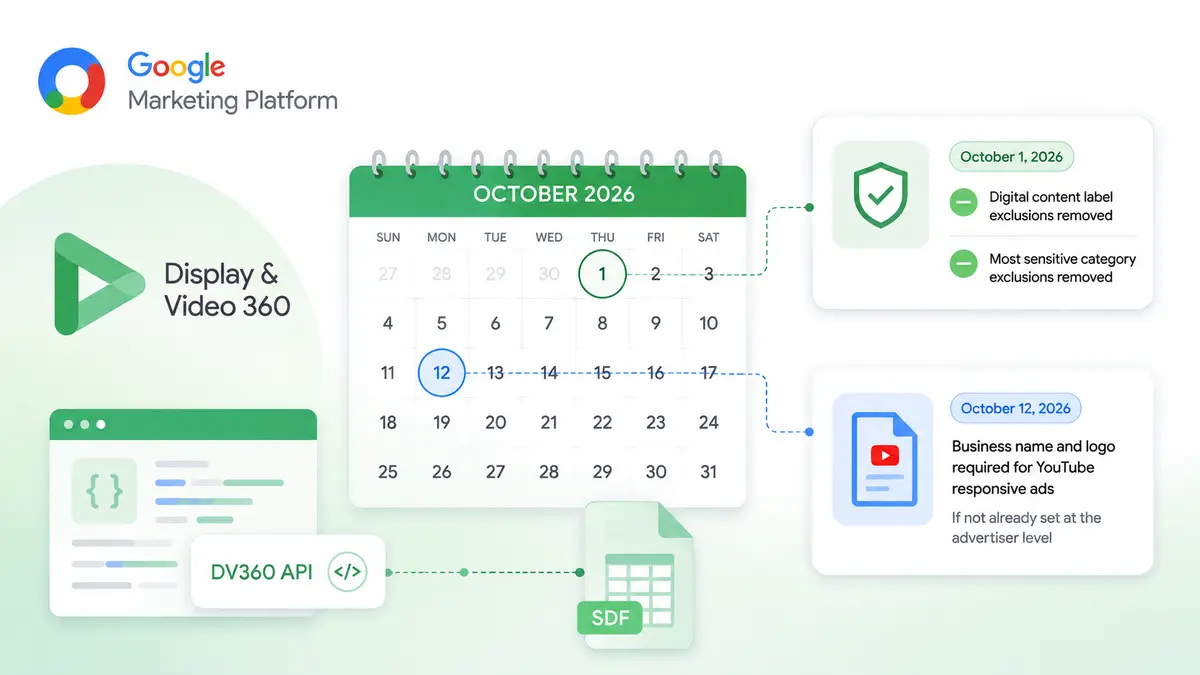
Google is making three unversioned changes to the Display & Video 360 API and Structured Data Files in October, removing some content exclusion options and introducing new requirements for YouTube responsive ads. Because these DV360 API changes are unversioned, developers with existing integrations may need to adjust now rather than waiting to migrate to a newer API version.
Oct. 1: Digital Content Label Exclusions Removed
Starting Oct. 1, advertisers will no longer be able to use targeting to exclude specific digital content labels through the DV360 API. The change affects available TARGETING_TYPE_DIGITAL_CONTENT_LABEL_EXCLUSION targeting options as well as valid values in the "Digital Content Labels - Exclude" column within Line Item Structured Data Files.
Oct. 1: Most Sensitive Category Exclusions Removed
Google is also removing the ability to exclude the majority of sensitive categories using targeting from the same date. That affects TARGETING_TYPE_SENSITIVE_CATEGORY_EXCLUSION options in the API and the "Brand Safety Sensitivity Setting" and "Brand Safety Custom Settings" columns in Line Item Structured Data Files.
Oct. 12: Business Name and Logo Required for YouTube Responsive Ads
A separate change takes effect Oct. 12, when Google will require a business name and logo when developers create or update YouTube responsive ads. The requirement applies when default business name and logo values haven't already been assigned to the parent advertiser, and also affects advertisers and developers uploading ads through Ad Structured Data Files.
Why It Matters
Removing content label and sensitive category exclusion options could require advertisers and platforms relying on those targeting controls to review their existing brand-safety workflows — replacing what exclusions used to handle with something else.
Meanwhile, integrations that create or update YouTube responsive ads need to ensure the required business identity assets are available before Oct. 12 to avoid workflow problems.
What to Do Now
Google is advising developers who believe their integrations will be affected to follow the recommended actions outlined within its individual deprecation descriptions.
That makes it worth auditing integrations ahead of October, particularly those managing content exclusions or automating YouTube responsive ad creation through the API or Structured Data Files.
Brand safety controls shrinking on the platform side also means advertisers have to establish their own baselines. As with platforms grading their own performance, fewer control levers shifts weight onto after-the-fact verification. If you handle YouTube creative, Google's new creative guidance is worth reading alongside.