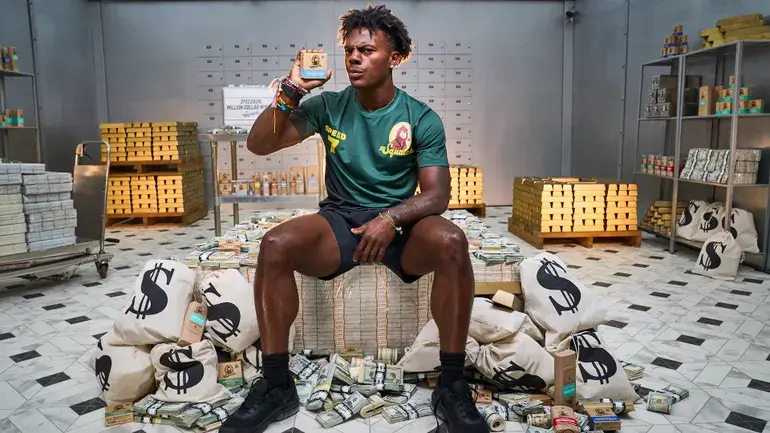
Dr. Squatch announced "Speedrun: Million Dollar Mission," a multistage contest doling out $1 million in prize money in collaboration with popular streamer IShowSpeed. It spans 25 challenges across nine weeks in the U.S., Canada, the U.K. and Australia.
The Unilever-owned men's grooming brand is teaming with a content creator who has quickly become a go-to partner for reaching Gen Z. What stands out is the shape of the creator collaboration: it forgoes traditional advertising for an activation designed to engage communities of consumers, rather than using creators and streamers in the top-down way brands previously used celebrity talent.
"Get the Community Activated, and Out of the House"
Chief Brand Officer John Ludeke explained: "We wanted to work with Speed and his team to create something that we thought would be really unique and different, and add a lot of value to his community and to our community, and social media in general. The goal for this one was really to be very participatory, to get the community activated and to hopefully get outside of their house to do something a bit different."
How the Game Works
Gameplay takes several forms.
A briefcase filled with a gold bar of Dr. Squatch soap is hidden each week in cities across the participating countries. Each week the brand shares a livestream of and GPS coordinates to the briefcase location, which become gradually more legible as the week goes on.
Retail integration turns more than 4,000 Walmart stores in the U.S. and Canada, plus other select partners, into contest hubs, with in-store displays and QR codes connecting shoppers to the game.
Weekly missions inspired by Speed's content — like challenging a stranger to a footrace — can be posted on TikTok, Instagram or YouTube for a chance to win. Ludeke hinted some challenges could be tied to in-store Walmart visits.
Scratch-off tickets are available free via a microsite or with purchase of an IShowSpeed Loot Box Bundle on TikTok Shop, with 25 scratchers revealing $10,000 prizes.
Prize values for the briefcases and content challenges increase over the eight-week contest, with a $250,000 briefcase challenge as the grand finale. The brand expects attention and frenzy on social media to rise along with the prize values.
"People love to create content, they love to share it, they love to participate," Ludeke said. "We wanted to give people another mechanism where they could participate and have fun."
"Speedrun" runs through Oct. 31. It was developed with Applied MSCHF, the agency arm of the Brooklyn production company behind viral stunts like the big red boots and Lil Nas X's Satan Shoes.
Media Budget Redirected to a Creator Community
Dr. Squatch has worked with IShowSpeed and his team since April 2025 to find the best way to bring a partnership to life, finding synergy between the brand's mission to inspire men toward healthier choices and the streamer's energy and desire to do things on his own terms.
The brand did shoot a basic set of ads to launch the contest. But more of its marketing spend goes toward supporting a creator community that will bring hundreds of pieces of content into the social ecosystem.
"We're going to be working with hundreds of different creators and influencers that are going to be out there also participating in the challenges to show people how it can be done, and to help build that content flywheel," Ludeke said. "Instead of pushing hard from top down, the goal here is to be a lot more bottom up."
Getting the C-Suite On Board
Spending $1 million on prize money rather than traditional media carries risk and requires navigation of the C-suite.
"It's pretty easy to calculate how many impressions we could generate, what that ROI was going to be, but from the beginning, the goal for this campaign was not to focus purely on standard metrics and to buy as much ad content as we could," Ludeke said.
The Takeaway
The structure reads in three parts: a format where participation is itself the content (challenge uploads); a mechanism connecting the online game to physical visits (4,000+ Walmart stores, briefcases hidden in cities); and an escalating prize structure that compounds attention over time.
The pivotal decision is refusing to convert prize money into media equivalents. Measured on impressions alone it's a losing calculation; add the content produced and that content's reach and the picture changes. The same reasoning appears in Hoka feeding runner data back into billboard creative and Hershey's translating the "Pinky Up" motion into participatory murals.