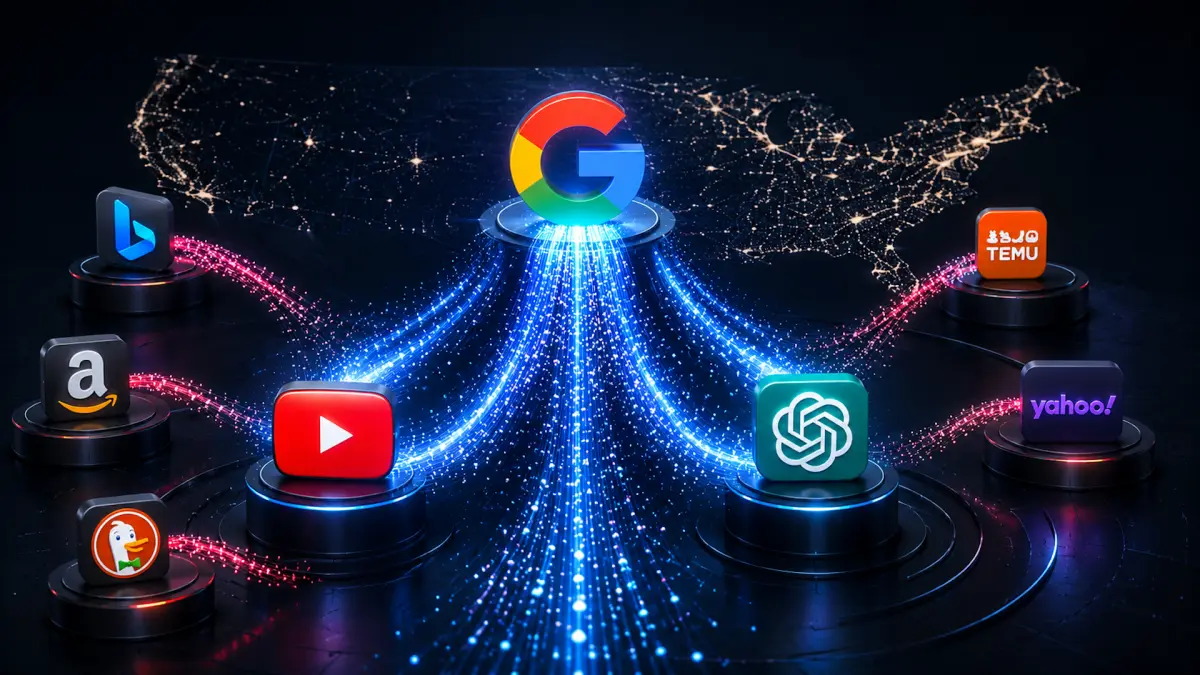
Who gained website traffic in the U.S. over the past year and who lost it? A new analysis compares traffic-estimate data from July 2026 against the same period a year earlier. The top of the rankings barely moved. Below it, traffic was redistributed unevenly, and ChatGPT overtook two search engines. The warning that follows the numbers is the more important part: the tool most SEOs rely on to measure any of this, GA4, is losing its ability to say where visitors come from.
Why the measurement baseline broke
Google Analytics 4 became mandatory on July 1, 2023, when Universal Analytics stopped processing data. Less than a year later, on May 14, 2024, Google began rolling out AI Overviews to U.S. users. The industry lost a clean, comparable baseline at exactly the moment search traffic patterns started to shift. That is why the author turned to third-party traffic estimates instead of GA4 for the comparison.
The giants did not move. Their traffic did.
The top three look identical to a year ago: Google first with 25.3 billion monthly visits, YouTube second with 10.3 billion, Reddit third with 2.61 billion. Glance at the rankings and you would conclude nothing changed.
- Google's traffic is up 10.72% year over year.
- YouTube is up 36.6%.
- The top three sites generate 54.3% of the top 10's traffic.
- Total visits across the top 150 U.S. sites rose only 6.1%, and the top 10 still account for 68.6% of it, versus 68.8% a year ago.
The web is not getting less concentrated as AI changes search. It is getting more so, with a couple of new names inside the circle.
The clearest winner: ChatGPT
ChatGPT.com is up 48.38% year over year and now ranks ninth among all U.S. websites with 1.09 billion monthly visits, ahead of DuckDuckGo and Bing. An AI chatbot outranks two search engines that have existed since 2008 and 2009. TikTok, by contrast, sits at 14th with 573.6 million visits and a modest 1.63% gain. New platforms are not winning across the board. Generative AI specifically has moved from novelty to habit fast enough to register as one of the biggest gains in the top 20.
Other winners that are not chatbots: LinkedIn climbed from 21st to 19th, up 15.48% to 473.7 million visits and into the top 20 for the first time in this data set. USPS.com is up 12.04%. Twitch rose five spots to 25th on a 25.6% jump. Comix.to posted the largest percentage gain of any site examined, up 37.3% and 14 places to 56th.
The losers are more interesting
The steepest decline in the top 20 belongs to Bing, down 50.43% year over year. Microsoft has spent three years and enormous sums bolting Copilot onto Bing, and the traffic data suggests the bet has not paid off as hoped.
Temu is down 28.55%, with a clear cause: the closure of the de minimis tariff exemption on low-value Chinese imports in mid-2025 gutted the pricing advantage that built Temu's U.S. business, and its ad spend and app rankings collapsed alongside. That is a trade policy story showing up in traffic data, not an SEO story.
The rest of the list mixes the predictable and the surprising: Amazon down 15.31%, Yahoo down 13.82%, DuckDuckGo down 15.83%, ESPN from 19th to 24th (visits down 16.0% to 366.0 million), NBCNews.com down 35 places to 145th with visits off 20.2%. The causes differ, but together they say something the "Google and YouTube still win" headline misses: traffic is being redistributed well below the three positions everyone watches.
The part that should worry SEOs
The author opened the GA4 account of a niche publisher he advises pro bono and compared Jan. 1 through Aug. 26, 2026 with the same period in 2025. On the surface it is great news: sessions up more than 105%, engaged sessions up almost 111%, key events up about 80.5%.
Keep reading the same report and direct traffic is up more than 157% and now accounts for over 78% of total traffic, up from about 62.5% a year earlier. GA4 cannot identify where nearly four of every five visitors came from, and that share grows every month. "Direct" is not a source. It is the label GA4 attaches to everything it cannot attribute, and an increasing share of that is almost certainly arriving from links generated inside AI chat interfaces, which routinely strip the referrer data GA4 depends on.
GA4's native AI Assistant channel, added May 13, 2026 to track visits from ChatGPT, Gemini, DeepSeek, Copilot and Grok (Google's own AI Overviews and AI Mode are excluded), did not help. Only 0.47% of this site's traffic since that date landed in the channel. Whatever AI traffic the site receives is not showing up where it is supposed to. Other data sets point the same way: see 22.4% of AI Overview Traffic Gets Misattributed to Direct — Nine Months of Tracking Data and Only 1.1% of News Publisher Visits Carry an AI Referrer — Why Referral Data Undercounts AI.
So is this publisher winning? The historical metrics look fantastic. The attribution underneath them gets worse every month, which means the next round of content and channel decisions will rest on data that is losing the ability to explain itself.
The author's prescription: stop staring at the rearview mirror
Pay less attention to what GA4's 19 default channels claim about where traffic came from. Pay more attention to tools built to see the road ahead: domain-level traffic estimators, audience research tools that show what a target audience reads, watches and follows, multi-market consumer panels and brand perception surveys, and direct customer surveys. Pairing survey tools that capture explicit feedback with analytics that decode implicit intent gives you both the exact phrases customers use and the content gaps they reveal.
What to take from this
If direct traffic keeps climbing in your monthly report, read it as a measurement failure, not a win. Add brand search volume trends, monitoring of whether your brand is cited inside AI answers, and a one-line "how did you hear about us" survey as supporting indicators. For a structured way to do that, see A 5-Layer Framework for Measuring AI Search Performance. Next year's winners will be the sites that measure what GA4 cannot see.