iPullRank analyzed 13.1 billion search events from 9.1 million opted-in users, covering October 2024 through December 2025, to understand how Google users behave when they search and where their clicks ultimately go. One standout finding for paid search marketers: ChatGPT's unusually high share of paid traffic.
By the numbers
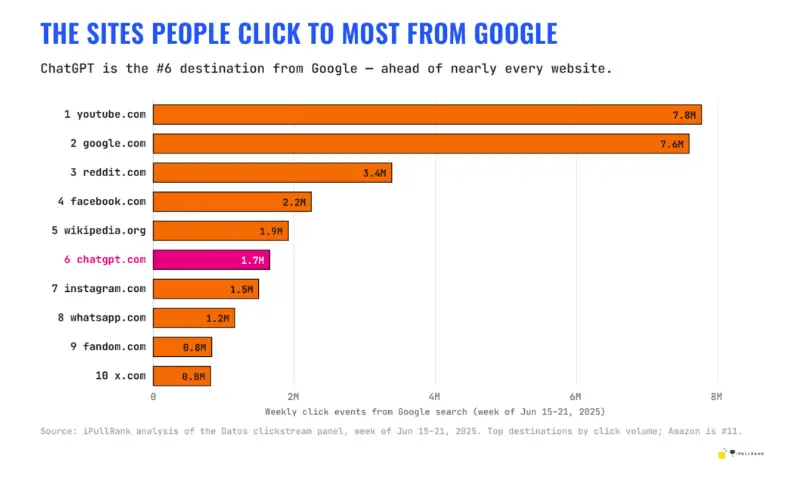
ChatGPT was the sixth-most-clicked destination from Google Search in the dataset, trailing only YouTube, Google's own properties, Reddit, Facebook and Wikipedia. Millions of searches for ChatGPT occurred each week within the panel.
More significantly for advertisers, iPullRank found ChatGPT drew a greater proportion of paid clicks than any of the other leading Google destinations analyzed. That suggests OpenAI isn't relying solely on organic visibility or direct traffic. Paid search is also moving people from Google to ChatGPT.
A destination Google struggles to replace
ChatGPT also appears relatively difficult for Google to substitute with its own search features. Only 11.1% of searches that would otherwise lead toward OpenAI were intercepted by a zero-click Google experience — one of the lowest rates among major destinations studied.
That is partly because many ChatGPT searches are navigational. Google can answer a factual question directly in Search, but it can't fully satisfy someone whose intention is simply to open ChatGPT.
Paid clicks are holding up
There's another signal here for Google Ads advertisers. Over the 15-month study period Google's overall zero-click rate rose about 2.6 percentage points, while the share of searches producing an organic click fell roughly 2.8 points. Paid clicks showed no meaningful change.
That doesn't mean paid search is immune to changing search behavior. But within this dataset, zero-click growth appears to have come primarily at the expense of organic clicks rather than ads.
Brand bidding still matters
The study found paid clicks more common on branded searches. When branded searches resulted in a click, 4.4% were paid, compared with 3.3% for non-branded. iPullRank describes this as evidence of brands paying to defend their own names in search results.
That context applies to ChatGPT directly. People searching Google specifically for "ChatGPT" represent highly valuable navigational traffic, making prominent paid placement potentially useful even with strong organic visibility. The research doesn't reveal which queries OpenAI bids on or how much it spends, so it can't establish how much of ChatGPT's paid traffic comes from defensive brand bidding.
Search is still a discovery engine
Another notable finding: only about 14% of Google clicks went to a website explicitly named in the user's query. The remaining 86% were discovery clicks, where Google sent users to destinations they hadn't specifically requested.
For advertisers that matters, because it means Google's value isn't limited to capturing existing brand demand. A large majority of clicks remain contestable territory where ads, rankings and other search experiences can introduce users to a destination.
What this means for marketers
ChatGPT's position as both a Google competitor and a significant recipient of paid Google traffic shows how intertwined traditional search and AI discovery are becoming. For paid search marketers, the emerging AI journey isn't simply Google versus ChatGPT. Increasingly it is Google to ChatGPT — with an ad helping users get there.
Three practical conclusions.
The case for defensive brand bidding strengthens. Higher paid click share on branded searches means competition happens above your own brand results even when you hold the top organic spot. Even a company like OpenAI is buying there.
Don't misread organic decline as search decline. Zero-click growth ate into organic while paid held. Cutting total search budget on the basis of falling organic traffic cuts the channel that is still working.
Traffic heading toward AI tools is acquirable too. In Korea, OpenAI has begun piloting ChatGPT ads. AI services are simultaneously becoming buyers and sellers of advertising.
And traffic arriving that way behaves differently from conventional search traffic. As covered in LLM Referral Traffic Converts at 20%, a different arrival path calls for a different landing page. Buying the traffic and converting it are separate jobs.