As work, study and leisure run later into the night, the composition of late-night convenience store purchases in Korea is changing. Shoppers are buying fuel to keep going and quick meals to replace a delayed dinner, and the basket has broadened accordingly.
Snacks lead the count, energy drinks lead the growth
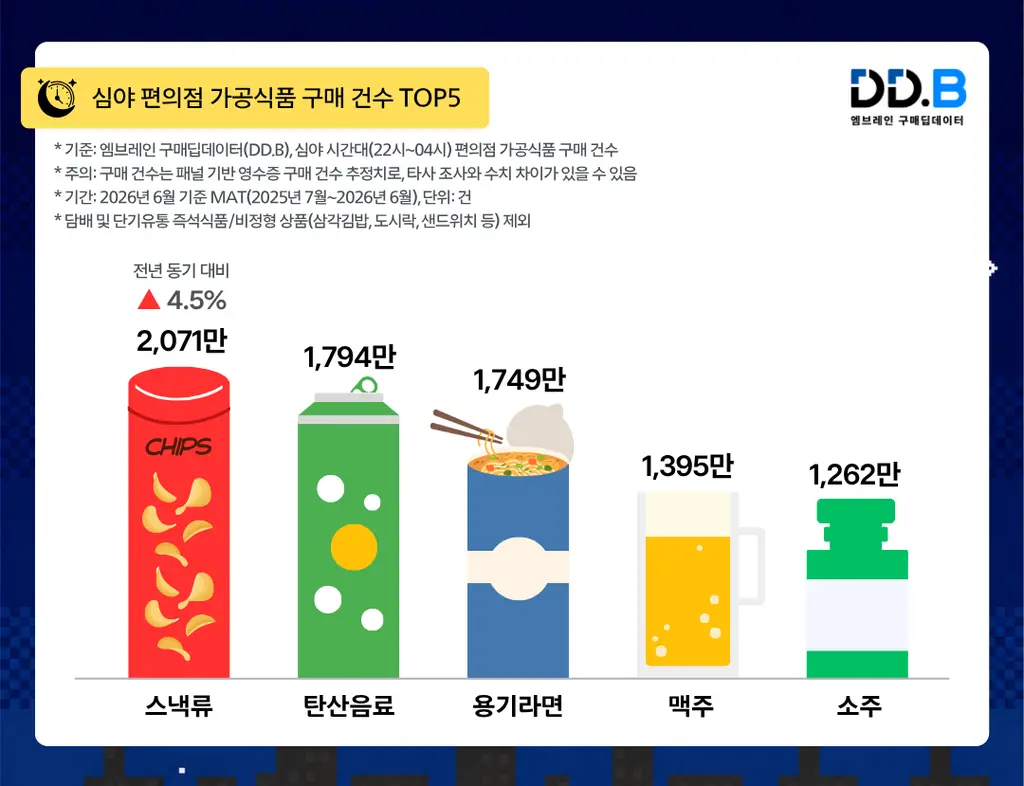
According to Embrain's purchase deep-data panel (DD.B), for the 12 months ending June 2026 (July 2025–June 2026), the most purchased category in convenience stores between 10pm and 4am was snacks, with roughly 20.71 million transactions, up 4.5% year over year. Carbonated drinks followed at about 17.94 million, cup ramen at about 17.49 million, beer at about 13.95 million and soju at about 12.62 million.
The movement sits further down the table. Energy drinks reached about 7.33 million transactions, up 41.5%, and rice-based meals about 2.91 million, up 38.7% — both growing near 40%. Beer fell 9.2% and RTD coffee fell 10.1%.
Two different late nights, by age
Among consumers in their twenties and younger, growth concentrated in energy drinks (+59.1%), biscuits (+62.6%) and carbonated drinks (+39.2%), alongside quick hunger fixes like cup ramen (+9.3%) and bread (+3.2%) — consistent with study, work and leisure extending later.
Among consumers in their fifties and sixties, the standouts were ice cream (+35.2% and +38.0% respectively) and bread (+27.2% and +11.5%). Same hours, different purpose: younger shoppers buy to keep going, older shoppers buy to wind down.
How to use it
First, late night is no longer an alcohol daypart by default. Beer and soju still rank high, but their trend line is down while growth sits with stimulants and ready meals. That justifies rebuilding late-night promotions around energy and quick meals rather than alcohol-and-snack bundles.
Second, cross time of day with age or the message misses. After 10pm, under-30s respond to language about staying focused; shoppers in their fifties and sixties respond to language about closing out the day. One late-night creative aimed at both usually lands with neither.
Third, treat the figures as panel-based estimates. These numbers come from Embrain's DD.B receipt data drawn from a 20,000-person panel, and sampling design, category definitions and aggregation rules can produce differences from retailers' official disclosures. Use the direction, not the absolute values.
For a related read on a Korean retailer extending its core strength into a new category, see K-Beauty 3.0 Goes Vertical — From Brands to Distribution, Platforms and Curation.