Australia's eSafety Commissioner published a report examining the effectiveness of the country's under-16 social media ban. The finding: despite gradually improving enforcement from major platforms, most underage teens are still getting into social apps.
Accounts fell, usage mostly didn't
The report follows April's three-month update and surveys a selected group of 4,121 children aged 10 to 16 living in Australia, plus one parent for each.
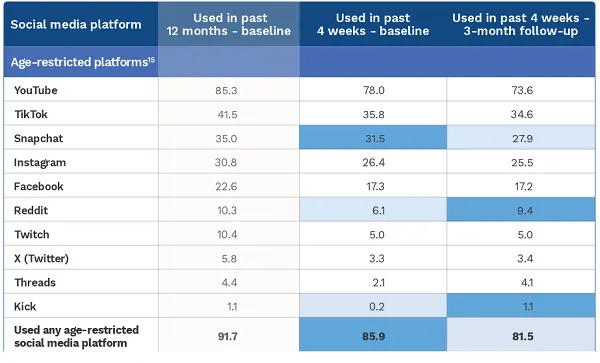
When the ban took effect, 85.9% of Australian teens reported regularly using at least one age-restricted platform. The latest figure is 81.5% — a slight decline. Account ownership dropped; usage did not. As the report explains: "We note that several social media platforms can be accessed without logging into an account. Children may also use social media through accounts belonging to others, such as parents, siblings or friends. Given this, and the discrepancy between the proportion of children who reported holding their own social media account and the proportion who reported using social media platforms, the data reported here likely reflects usage both with and without children being logged into their own account."
One app actually moved
Snapchat was the only app with a significant decrease in teen use, falling from 31.5% at launch of the ban to 27.9% at three months. Meanwhile more underage teens reported using Reddit and Kick — plausibly a spillover from being pushed off the larger apps.
The gap is age assurance, not evasion
The primary reason children still held age-restricted accounts was "ineffective implementation of age assurance measures by platforms." Half — 50.2% — said the platform had not yet asked them to confirm their age, and 18.2% said the platform had incorrectly estimated their age. Deliberate bypassing showed up mainly as listing an age of 16 or above (37.1%), while parental assistance and VPN use were less common.
The pre-launch fear that kids would simply VPN around the rules has not materialized. Then again, when access is already available by easier means, there is little reason to bother.
Time did not move offline
The report found young teens spending more time in messaging apps and online games as a result of the change. "At three months, most children reported that there was little to no change in their engagement with offline activities, behaviours associated with problematic online use, and their wellbeing."
The assumption that banning apps sends kids outdoors ignores that social behavior has already reorganized around online connection. Blocking one channel does not reverse how a generation forms relationships. The data also showed no impact on the harmful behaviors the ban was theoretically enacted to address.
What marketers should take from it
Regulation does not automatically mean lost reach. With substantial logged-out usage, teen audiences disappear from account-based targeting while content consumption continues — meaning they vanish from measurement first.
Expect regulation to keep shifting from prohibition toward mandated product design, as in the New Mexico ruling against Meta covered in Meta Fined $567M Over Teen Safety — and Ordered to Cap Usage at 90 Hours a Month. Korea's version of the debate is in Korea's Youth Social Media Rules Hinge on One Question — Is YouTube Shorts In or Out?.