Walk into an appliance store lately and you may notice yourself asking about the care plan and services before asking about specifications.
In 2026, the appliance market is undergoing another tectonic shift as AI steps out of the screen and acquires a body — the era of Physical AI, where systems perceive their environment and move through it.
The end of the spec race
As Chinese appliance brands aggressively expand share into large appliances and the high end, competition on raw hardware specifications and price-performance has hit its limit.
In response, Samsung Electronics and LG Electronics are redefining the rules through software platforms and mobile AI home companions — household robots — rather than device sales alone.
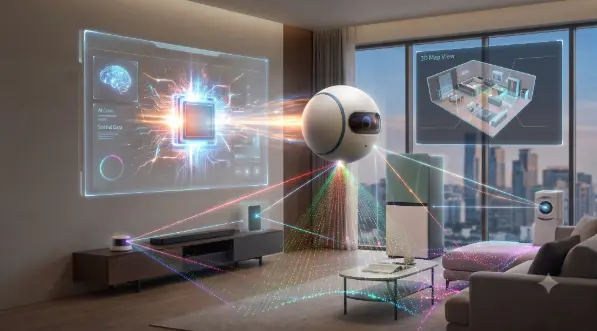
Samsung's spherical robot Ballie and LG's mobile AI home hub Q9 are not toys. They observe the occupant's situation in real time and act as command centres that autonomously control other appliances in the space.
That is the crux: companies are seizing the vast data generated inside a customer's living space to shift the business toward recurring revenue built on subscriptions and connected platforms.
Embodied AI needs physical data
For Physical AI to work in daily life, computation in virtual space is not enough. It requires multidimensional physical data from the real world.
LG Electronics recently converted its Yangjae R&D Centre in Seoul into Korea's first robot-dedicated Data Factory. Inside a facility replicating actual home and factory environments, roughly 100 LG CLOiD robots collect large volumes of real motion data — grip pressure, collision avoidance — used to train the Robot Foundation Model (RFM) that serves as the robots' AI brain.
Which produces new form factors
That maturation is producing form factors that directly displace household labour.
The premium cleaning robot LG Hom-Bot AI Objet Collection RONi is the first in the world to apply 100°C steam in both the main unit and the station, handling everything from ingrained floor grime to 99.99% sterilisation of harmful bacteria.
More striking is the Hidden Station at just 15cm tall, which embeds perfectly into the kickboard space beneath a kitchen sink without cabinetry modification — realising the "Invisible Kitchen" trend that leaves interior aesthetics intact.
Note what happened there: a technical specification became an interior design requirement.
What marketers should sell: not features, but a locked-in routine
The combination of Physical AI and subscription services demands a genuinely different communication strategy.
1. Lifestyle bundling as a lock-in mechanism
Appliance subscriptions go beyond rental, bundling regular steam hygiene servicing, free consumable replacement, free removal and reinstallation when moving, and multi-product discounts to defend against churn.
Marketers should not be selling suction power or specifications. The approach is to get customers to subscribe to an entire routine: a relaxed daily life freed from household labour, with no maintenance to think about.
2. Context-aware 'family care' messaging
Samsung SmartThings has strengthened family care and safety patrol features that use the robot vacuum's camera and microphone to detect a family member who has fallen, or analyse activity changes and alert their children.
Alongside services like Map View, which renders the home as a 3D virtual floor plan for intuitive room-by-room device control, the marketing centre of gravity should be a message of empathy and reassurance — advanced technology attentively caring for me and my family.
3. Absolute trust in security
The more household robots that roam a space collecting camera and sensor data become mainstream, the more acute privacy concerns become.
Hardware security technologies must therefore lead the pitch: LG Shield, with proprietary data encryption and a physical camera shutter, or Samsung Knox, with top-tier security grading based on the Matter 1.5 standard.
Security belongs in the purchase criteria, not in the feature appendix.
From hardware manufacturer to lifestyle platform
In 2026, the appliance market has equipped itself with a new body in Physical AI and a powerful business model in subscription. It marks the industry's evolution from one-off hardware sales into a comprehensive lifestyle platform connected to the customer's daily life.
Going forward, companies and marketers must stop listing fragmentary product features and instead prove what irreplaceable, personalised experience they will continuously deliver on the basis of the spatial data Physical AI collects and analyses.
The move toward AI in physical form is not confined to appliances. Software companies are looking the same direction — see OpenAI's First Hardware Is a Keyboard: What Codex Micro Is Really Asking — and the unresolved leg of AI commerce is covered in Kakao's AI Commerce Push: Recommendations Are Done, Checkout Is the Test.