Should content strategy stay focused on a few core topics, or go broad to widen the funnel? New analysis by SEO analyst Kevin Indig, using Semrush AI Visibility Toolkit data, tests how topical authority behaves in AI search.
The headline finding: brands have good odds of being cited outside their established expertise, but not of being mentioned — that is, recommended.
The data
The study uses Semrush's U.S. ChatGPT dataset covering 1,094 categories with five prompt variants per category, January through June 2026. The breadth models draw on 283,215 citations and 76,493 named-brand-mention observations, each paired with the following month's outcome. The relatedness test draws on 45,578 expansion appearances by 1,458 mapped brand entities. Every number is an association after controls, not proof of causation.
1. Citations and mentions follow different rules
Embedding the ~1,000 categories and matching them against each brand's core expertise by semantic similarity produced a clear split.
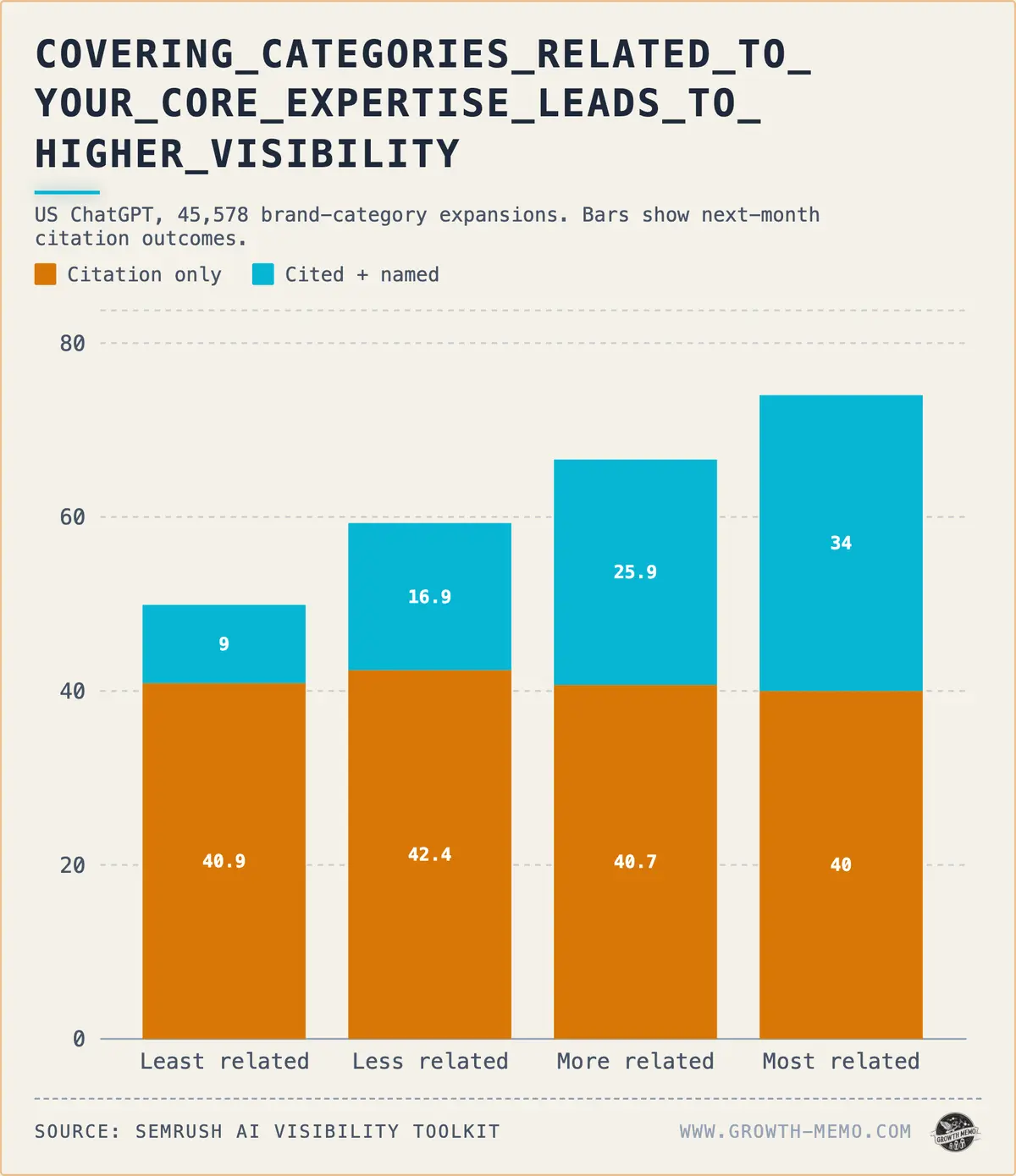
- In categories distant from core expertise: 50% of appearances are citations, only 25% are mentions, and 9% are both
- In close categories: 74% cited, 44% named, 34% both
- Citation-only presence barely moves with relevance: 41% in distant categories versus 40% in close ones
In other words, you can be a source on almost any topic if you meet the normal criteria for citation. The AI recommends you in your core topics.
2. The penalty is shallowness, not breadth
A domain can surface once in 20 categories and own none of them. Depth measures how many of a category's five prompt variants a domain appears in; breadth measures how many categories it appears in at all.
For citations, appearing across many categories carried no penalty. The association rises from +0.012 at 1-of-5 prompt appearances to +0.062 at 5-of-5.
Brand mentions behave differently. Appearing in only 1 of 5 prompts across the categories a brand shows up in is associated with a lower mention share at -0.051; at 5-of-5 it turns slightly positive. That is a small but robust effect: brands that actually own a category expand into others more successfully.
The "spread too thin" penalty is really a penalty for shallow presence, not for breadth itself. There is no defensible universal category limit, and the data does not support unlimited expansion either. The associations are also light — writing style, overall brand authority and third-party web mentions may outweigh topical authority entirely.
3. Industries differ
Finance and real estate: expansion pays
In finance, the citation-breadth association rises from +0.054 at one prompt variant to +0.139 at all five. Real estate rises from +0.021 to +0.135. In these markets, repeated broader coverage is associated with stronger source visibility, making category expansion a viable citation strategy.
Legal and healthcare: cited, not recommended
In legal, the mention-breadth association stays negative even at full five-prompt coverage (-0.058); healthcare follows at -0.037. More consistent coverage improves citation position but does not reliably translate into named-brand visibility. These are higher-stakes decisions, where being a credible source is not enough to become the recommended answer.
The practical rule
Finance and real-estate teams can test adjacent-category expansion with citations as an early success metric. Legal and healthcare teams need a higher bar. A category is not won until the brand earns repeat mentions, not just citations.
For the mechanics behind concept-to-source association, see Entity SEO: AI Search Looks for the Source of a Concept, Not a Keyword; for the channel strategy that produces citations, see From Media Relations to Machine Relations.