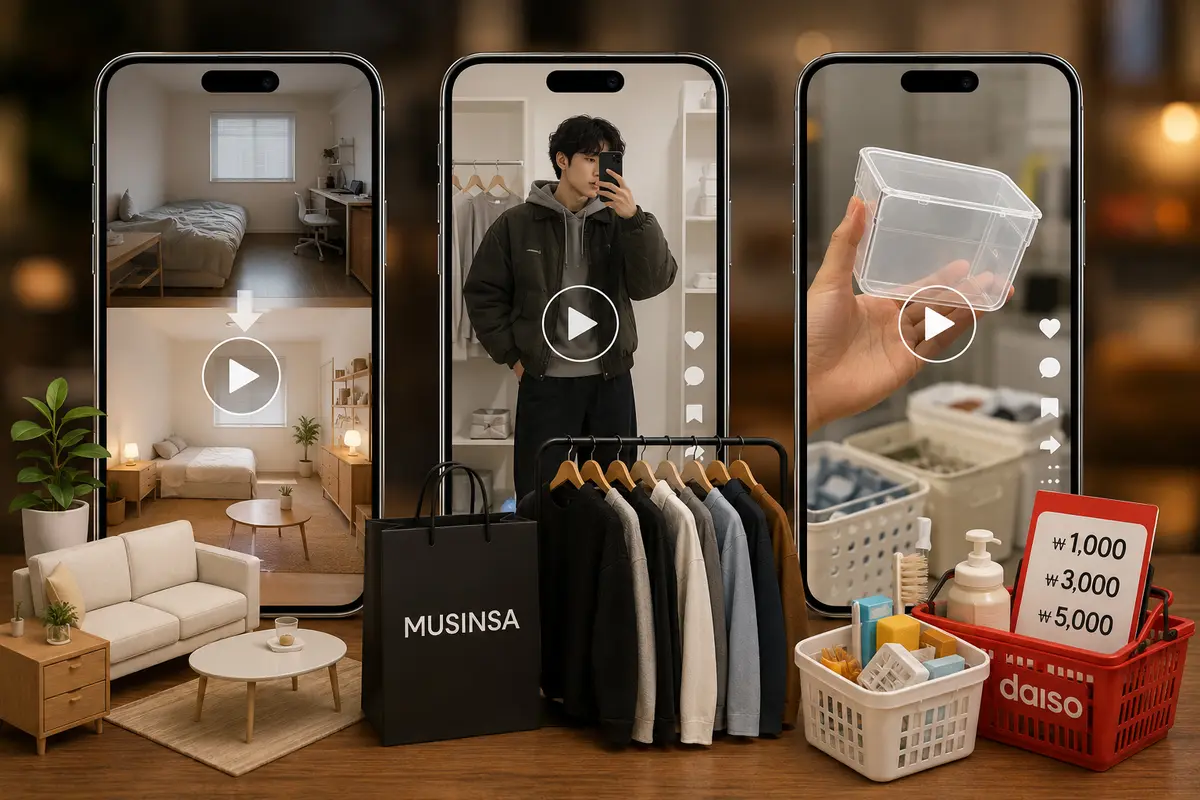
One Daiso "must-buy" video passed 2.2 million views and emptied store shelves. Ohou's short-form on furniture layout for studio apartments hit 8.08 million views and lifted the company's YouTube viewership 900% in three years. At Musinsa, short-form recommendation content from 4,400 influencers sold ₩120 billion of product in 18 months.
Different categories, products and audiences. But lay the three side by side and a repeating production pattern emerges. This piece organizes it into a short-form commerce formula: P.I.C.K.
1. Ohou — Problem and Solution Inside Three Seconds
Ohou's most-watched YouTube video isn't a long explainer but a short clip on furniture layout for a studio apartment, at 8.08 million views (per a December 2023 announcement). The channel passed 100 million cumulative views that year, with viewership up 900% in three years.
The structure is simple: show a room that looks hopelessly cramped, then cut immediately to the rearranged result. Before-and-after instead of explanation.
- Structure: the Before/After series (57 episodes, 38.63 million cumulative views) — problem state cut straight to solution
- Device: product tags that turn any furniture on screen into a purchase link
- Serialization: short repeating formats that keep viewers coming back
That same year, Ohou's renovation transaction revenue rose more than 3.5x year over year. The company hasn't directly tied viewership to revenue, but the timing coincides with the build-out of a funnel running from content into brokered renovation work.
2. Musinsa — Zero Distance Between Try-On and Checkout
Musinsa's curator content is fundamentally influencers trying on clothes and styling them in short videos. Launched in July 2024, the affiliate program passed 4,400 active curators in 18 months with cumulative transaction volume over ₩120 billion. During the 2025 winter Black Friday event (Nov. 16–26), about 640 curators produced 49,000 pieces of content generating ₩23.8 billion.
- Structure: try-on format showing fit and styling on the spot — size and fit information lives inside the video
- Device: a trackable purchase link on every video, so the moment of interest connects directly to checkout
- Incentive: commission of up to 10%+ on sales, pushing influencers to find the highest-converting shots themselves
Over the same period Musinsa posted revenue of ₩1.35 trillion (+8.9%) and operating profit of ₩140.5 billion (+36.7%) — profit growing more than four times faster than revenue. The company officially credits offline store expansion, exports and private-label strength; curator content is more accurately read as a channel that broadened the base alongside those.
3. Daiso — It Didn't Hide the Price
A household-goods creator's "Daiso must-buys" video passed 2.2 million views, and searching YouTube for Daiso recommendations surfaces multiple videos over a million views. What they share is rapid-fire product listing with the price (mostly under ₩5,000) displayed directly on screen.
- Structure: list format with fast cuts — high information density keeps viewers to the end
- Device: prices shown as on-screen text rather than narrated — the low price itself becomes the entertainment
- Result: one sheet mask was searched 3,186,901 times on Daiso's own store, topping restock requests; another ranked first among new products in the first half with over 50,000 units sold
Daiso's beauty category grew 144% year over year in 2024, slowing to around 70% in 2025. The company has never quantified how much specific videos drove that, but repeated sell-out coverage makes the circumstantial case clear.
4. The P.I.C.K. Formula
Four patterns repeat across all three:
P · Pain point hook — In the first three seconds, name the viewer's specific problem. Ohou opens on "how do I arrange furniture in this tiny studio?"; Daiso on "you're losing out if you don't know this."
I · Instant proof — Show, don't narrate. Ohou's before/after, Musinsa's actual try-on footage.
C · Cost anchor — Put price and offer on screen immediately. Daiso displays sub-₩5,000 prices as captions; Musinsa embeds sale prices and discount codes in the video.
K · Keyed CTA — Place the purchase link at the exact moment the product appears. Musinsa's trackable links, Ohou's product tags.
Consumer research backs the effect. In an April 2026 KT Nasmedia survey of 2,000 internet users, 24.7% said they had bought a product or service immediately after watching short-form content; a Korea Creative Content Agency survey put purchase conversion at 31.4%. In an Uppity survey of 710 Korean Gen Z and millennial respondents, 72.3% said they had purchased based on an influencer review or recommendation.
5. Pre-Production Checklist
- Does the first three seconds show the viewer's specific problem?
- Does it demonstrate rather than explain?
- Is price or offer visible on screen immediately?
- Is a purchase link or code attached at the moment the product appears?
- Are you producing consistent volume rather than betting on one hit?
The Takeaway
Ohou's before/after, Musinsa's try-on and Daiso's price reveal follow the same grammar despite different categories and formats: name the problem, show it immediately, don't hide the price, connect to purchase. Those view counts and sales figures weren't accidents.
The question isn't whether to make short-form — it's whether your content has all four P.I.C.K. elements. Scaling that grammar across a channel also requires turning tone of voice into rules and templates. For more on Korean commerce content, see also what K-beauty actually exports: a discovery system built on 2.4 billion TikTok views.