Kevin Indig crawled 3,000 listicles to isolate the variables associated with higher rankings. It follows last week's study of whether Google demoted listicles across 60,000 queries. The question this time is different: what makes a good listicle?
Recap of Part One
- Listicles are still everywhere. At least one true listicle appeared in the top 10 for 55.1% of the 60,000 queries analyzed, and in the top 3 for 32.3%.
- Query intent is the biggest lever. Google shows 5.3x more listicles when the query explicitly asks for a set of options.
- No universal demotion, but heavy reshuffling: only 52.5% of queries kept the same position-one URL between January and August.
- Publishers beat brands, supplying 46.8% of the highest-ranking listicles versus 19.2% for brands and vendors.
- The real threat is competition for attention. 92% of listicle SERPs carried Reddit or YouTube, and AI Overviews covered 83.7% of queries on average — 93.4% in B2B.
Freshness Was the Clearest Signal
More than 15 variables were analyzed, but most didn't survive the control checks. The clearest survivor was the date.
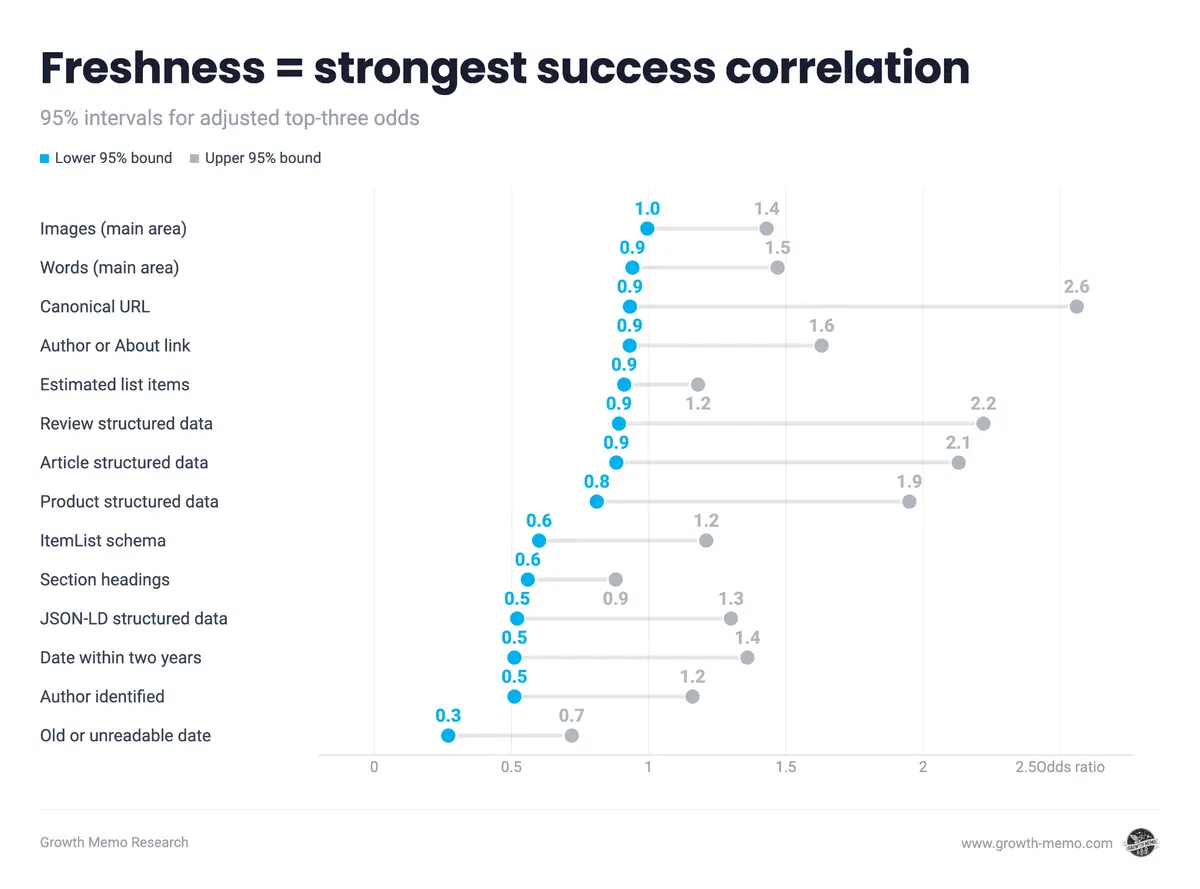
A date from the previous two years appeared on 66.6% of pages in the top 3, versus 57.3% of pages in positions 8-10. An old date, or one the crawler couldn't interpret, appeared on 8.2% of top-3 pages and 15.1% of pages in positions 8-10. After controlling for vertical, query wording and listicle type — filtering to one page per domain — an old or unreadable date was associated with 56% lower odds of ranking in the top 3.
Counted Listicles Win
A counted listicle carries an explicit item count or numbered-list evidence in its title or snippet ("17 Best Project Management Tools"). An editorial roundup recommends or compares options without an explicit number.
Across 6,114 SERPs where both formats appeared in the organic top 10, counted listicles took 56.8% of direct matchups. The best counted listicle averaged position 3.77 across 28,228 SERPs where one appeared in the top 10; the best editorial roundup averaged 4.59 across 10,791. When present in the top 10, counted listicles reached the top 3 55.9% of the time versus 41.4% for roundups.
The pattern wasn't universal. Editorial roundups won direct matchups in consumer technology, fitness and sports, and automotive; counted listicles won in the other 12 verticals.
Bigger Numbers in the Title Ranked Higher
Among explicit list queries, counted listicles with 51 to 100 in the title averaged a best organic rank of 4.11. Titles with 2 to 5 averaged 5.85. The leading title number is only a proxy for list length — a title can say "50 ideas" while the page contains fewer, more, or differently grouped items.
Top-3 pages had 21.5% more words and 38.9% more images at the median, but those differences didn't hold consistently across adjusted models.
More Headings Hurt
More section headings did not predict better position. A one-standard-deviation increase in heading count, after adjusting for unusually large values, was associated with 29% lower top-3 odds.
Signaling depth through a big number in the title earns higher rankings in this dataset; over-structuring the page with many headings works against you. "50 best tools" may signal comprehensiveness and match explicit list intent — but 50 products can appear in cards without creating 50 headings.
Self-Serving Listicles Are Alive and Well
Self-serving listicles published toward the end of last year grew traffic 3.5x more than the rest. But vendors putting themselves first is not what drove that growth. After accounting for starting traffic, industry, listicle type, current rank group and repeated pages from the same publisher, the advantage evaporated: self-promotion was associated with just 4% stronger growth, with a 95% interval running from 51% lower to 120% higher (p = 0.91).
Indig's read is that companies simply put more effort into listicles after realizing their role in AI search. The result still supports the argument that self-serving listicles work, even after Google demoted many of them.
The details: across 83 manually reviewed pages from 8 industries, median organic traffic estimates reached 1,977 in August 2026 compared with 568 for 600 control listicles. 74.7% of eligible B2B vendor comparisons put the publisher's own product first. Of 434 vendor-owned B2B listicles reviewed, only 83 compared the vendor with genuine peer alternatives.
If Ranking Yourself First Feels Wrong
Indig's recommendation to clients is to use third-party data as a proof point. If G2 reviews support you being "the best for x," you can write it with a clear conscience. If not, and if you care, listicles may not be the right format — leaning on an affiliate partner or creator may be the better route.
And AI Overviews Change the Premise
There's a structural dilemma in Google Search. When someone searches [project management software] and you're Asana, shouldn't you automatically appear? The answer is no, because there are only so many solutions and Google doesn't want to be on the hook for which brands show up first and why.
So Google links to third parties that curate brands — publishers and marketplaces. Hence listicles. Listicles are curations, and they let Google avoid taking a stance.
AI Overviews change that. In an AI Overview you get a clear recommendation for brands, a philosophical shift in how Google takes a position. Personalization and longer, unique prompts are part of what enables it. Listicles still rank well and may inform AI answers, but Google naming brands directly makes their value more questionable.
Methodology
This follow-up combines four analyses from the original study of 59,984 valid Google SERPs across 60,000 US English queries and 15 verticals. The counted-versus-roundup comparison included only SERPs where both formats appeared in the organic top 10, and a balanced sample of 3,000 currently ranking listicles was crawled separately.