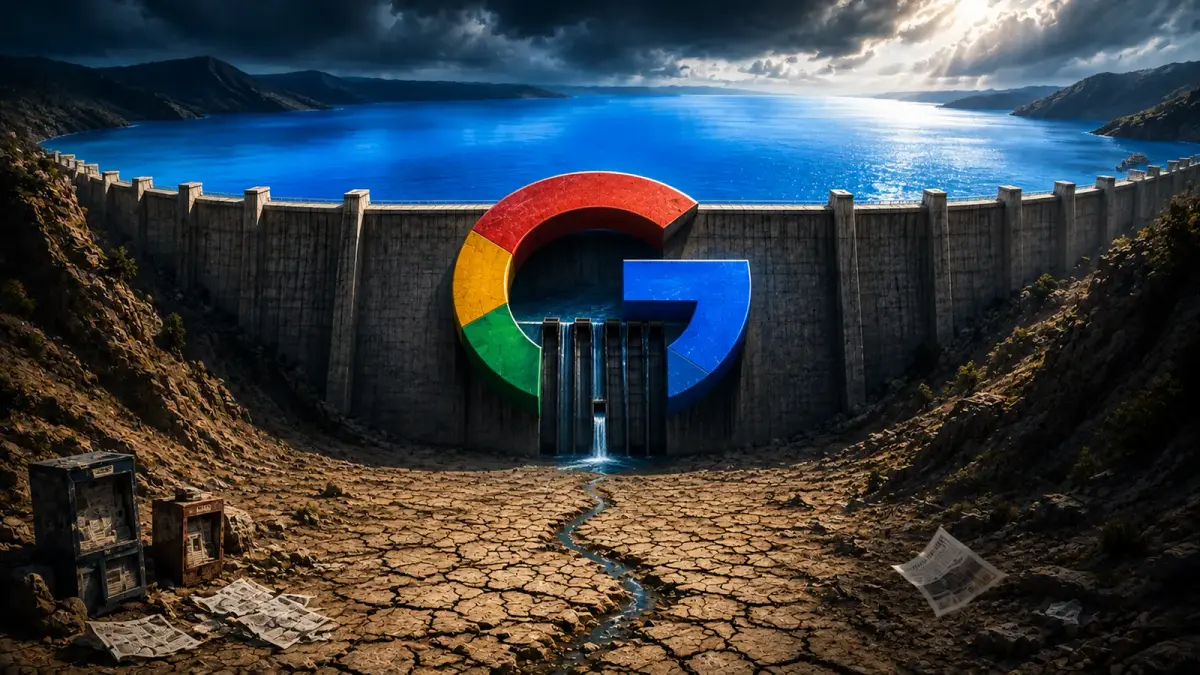
Nearly 300 French newspapers have filed a complaint against Google AI Overviews with France's competition authority. Their case rests on two claims: that AI-generated summaries sitting above organic results absorb clicks that used to reach news sites, and that launching the feature without publisher consent breached a 2022 compensation agreement.
What happened
APIG, the Alliance de la Presse d'Information Générale, filed the complaint shortly after Google rolled out AI Overviews in France in late July. AI Overviews place an AI-written summary at the top of the results page, above the traditional organic listings.
The publishers argue the feature further reduces traffic to their websites: instead of sending users to original reporting, Google answers the question inside Search. They also argue the rollout itself broke commitments Google made under the 2022 agreement on compensation for news content.
"The editors are not seeking to halt innovation. They are asking for this value to be shared, and for compensation of the use of their content," said APIG President Marc Feuillee. Google's position is that AI Overviews help people ask more complex questions and discover new content, and that publishers get tools to manage how their content appears.
This is a continuing dispute, not a new one
In 2024, France's competition authority fined Google €250 million for failing to comply with parts of the 2022 agreement. Separately, the European Union opened an investigation in December into whether Google used publisher content to train and serve AI systems without appropriate compensation.
Why marketers should care
This is not only a publisher story. When the claim that AI summaries absorb clicks is being argued in front of a regulator, the assumption that ranking equals traffic is formally under pressure — and brand content sits on the same mechanics. You can hold a top position and still see the session never happen.
Two practical consequences follow. First, measurement has to move. A reporting stack built only on sessions and last-click drops every bit of awareness created when an AI answer cites you. Citation and mention tracking needs to become its own metric line, read alongside lagging signals like branded search volume — the same breakdown described in Why Traditional Link Building Breaks in AI Search.
Second, content design matters more than the ruling will. Pages that get cited share traits: freshness, clear sourcing, structured information. As 76% of ChatGPT's Top-Cited Pages Were Updated Within 30 Days shows, refresh cadence is where cited content separates from neglected content. That variable is under your control while the regulatory process runs its course.
FAQ