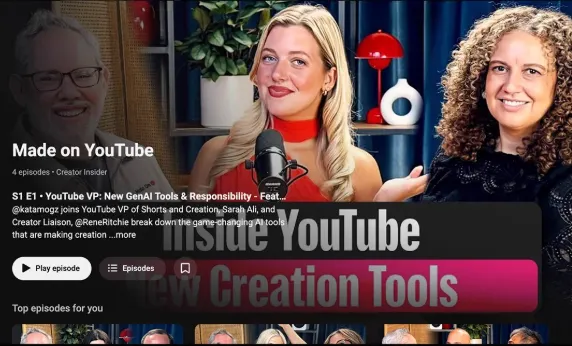
YouTube has updated its TV app, and the headline change is structural: creator playlists can now be designated as shows, complete with season organization and dedicated show pages. Connected TV (CTV) already draws more than a billion hours of YouTube viewing per day on home television sets. This update is an attempt to convert those hours into binge sessions.
Playlists Become Shows
Creators in the YouTube Partner Program can now designate playlists as shows inside YouTube Studio. The requirement is a set of high-quality videos sharing consistent themes and stories across episodes. Once designated, shows appear as featured series with immersive show pages and organized seasons.
For a viewer holding a remote, the difference is not cosmetic. A list of videos and a television series invite different viewing behavior.
Podcasts Were the Quiet Winner
YouTube also added Show and Podcast tabs to the Watch page. Podcasts have been an unexpected success in YouTube's CTV push — per CNBC reporting, users streamed more than 700 million hours of podcasts through their TV sets in October alone.
If your brand still treats audio as a commuting format, that number is a planning signal.
Navigation and Account Controls
- A Shorts access point now exists in the TV app.
- Previous and Next buttons are larger, deliberately steering remote-driven viewing behavior.
- Musician pages gained a new releases shelf.
- Account locking lets users protect history and recommendations behind a four-digit code.
- A parent code for the TV app blocks signed-out viewing by children.
- QR sign-in was streamlined, and casting plus the kids' Watch page experience were redesigned.
What Marketers Should Check
First, ask whether your existing video library can even be grouped into a series. Scattered one-off uploads will not qualify. Consistent format, consistent host, consistent topic — that library is ready for season-level restructuring today.
Second, remember that CTV traffic is programming-driven, not search-driven. Mobile YouTube is governed by search and recommendation; the TV screen is governed by whatever autoplays next. Episode retention matters more than thumbnail click-through.
Third, read this alongside the measurement shift already underway. YouTube changed how it counts views to register on playback start. As binge viewing rises and view counting loosens, the gap between surface numbers and real attention widens. Judge series performance by completion rate and next-episode entry, not raw views.
Bottom Line
This is less a feature release than a positioning statement. On the television screen, YouTube wants to be a channel with a schedule rather than a video library. The open question is whether brand channels are prepared to write for that format.