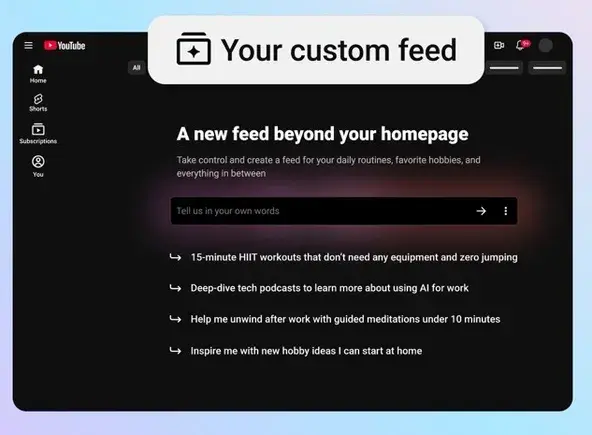
YouTube is expanding its custom feeds experiment. Users type a short prompt to create a personalized video feed, pin it to the top of Home, and switch between feeds there. The first test launched in November, expanded in May, and now supports up to eight active feeds per user — with unused prompts expiring after a few weeks, and an editable text box atop each feed to adjust its focus. The updated experiment is rolling out in the US to signed-in viewers on mobile (Android and iOS) and desktop.
The line that matters: chips get replaced
The most consequential detail isn't the feature itself — it's that custom feeds will replace the standard topic chips at the top of the Home feed in the mobile app. YouTube isn't adding an option; it's swapping part of its own algorithmic content display for direct user input. That's a striking move given that algorithmic matching has driven massive engagement gains across social apps. YouTube's bet is that combining explicit signals (prompts) with implicit ones (watch behavior) makes a more compelling feed — importing the conversational-prompt habit people learned from AI tools into feed design.
What it means for creators and brands
A fourth doorway to reach
YouTube reach has flowed through search, Home recommendations, and subscriptions. If custom feeds stick, a fourth doorway opens: feeds users defined themselves. Getting picked up there requires your channel and videos to be legible in interest-language — titles, descriptions, chapters, and captions that align with the words users actually type into a prompt. "Cooking vlog for people living alone" beats a vague "vlog"; the topic definitions people would realistically build a feed around become the target.
Niche gains value
Eight feeds are eight interest rooms. If users split their viewing into "home café," "investing basics," and "running," a sharply focused niche channel that fits one room precisely earns repeat exposure over a general channel that fits none. It's the same direction as YouTube's per-creator 24/7 channels experiment — see YouTube Expands Stations — Every Creator Gets a 24/7 Channel. YouTube is reorganizing viewing from an algorithm-fed infinite feed into rooms users enter with intent.
Our take: prepare prompt-legible language, not algorithm hacks
Platform algorithms have always been black boxes that marketers reverse-engineer from the outside — the exercise we documented in We Read X's Algorithm Source Code — 17 Filters Matter More Than the Weights. Custom feeds make part of that game transparent: what users will type is researchable, not guessable. Ask what prompts your customers would build feeds around — answer it with keyword research and customer interviews — and align your channel's topic definition and metadata to that language. It's a US-only experiment for now, but if it lands, one piece of YouTube SEO grammar changes.