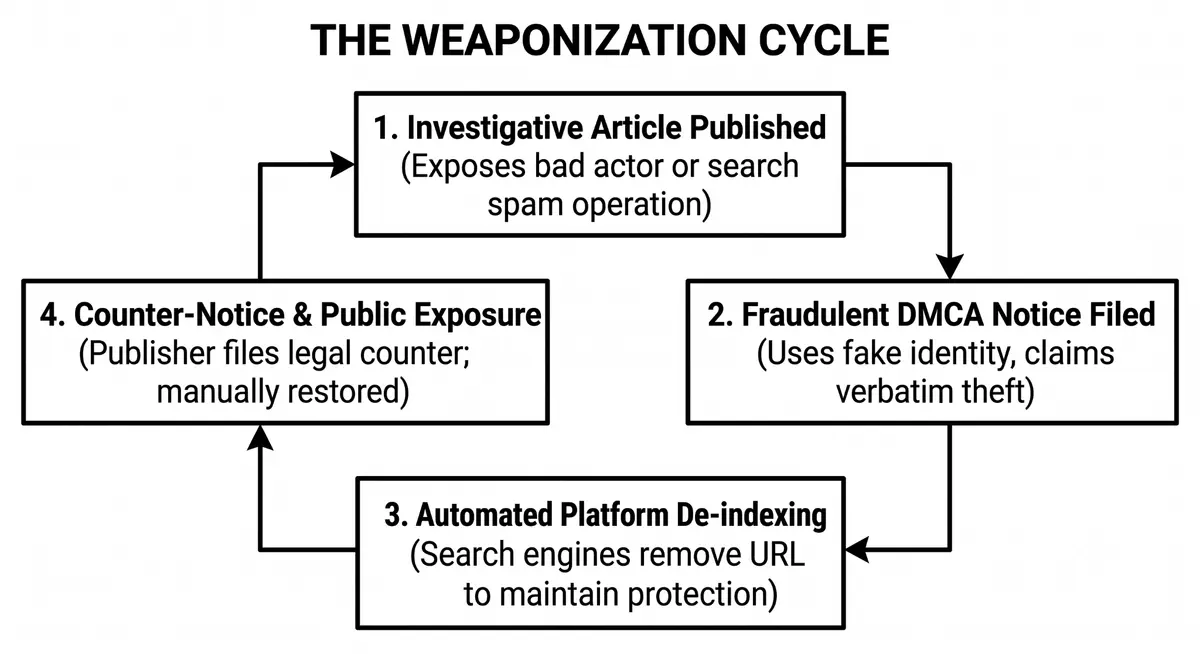
The Digital Millennium Copyright Act, passed in 1998, was built to protect creators from piracy while giving platforms a safe harbor. Under Section 512, search engines and hosts avoid liability as long as they act swiftly to remove flagged material. That word — swiftly — is the vulnerability.
The hole automation opened
Major platforms process millions of removal requests a month automatically, which means paths exist where no human reviews the claim. Bad actors use those paths to trigger deindexing on demand. A shield for intellectual property has become a tool for corporate censorship, reputation management and competitive sabotage.
The structural flaw is that Section 512 puts the burden of proof on the accused, not the claimant. Taking a page down carries virtually no legal risk for the platform; ignoring a notice risks a lawsuit. Speed beats verification every time.
A documented case
In March the abuse played out publicly. Press Gazette reported that a digital media firm had allegedly acquired established news domains to publish AI-generated gambling content — site reputation abuse, in SEO terms — and Search Engine Land published a follow-up. Within 48 hours both articles vanished from Google results worldwide.
An entity calling itself "US Webspam" filed a copyright complaint claiming word-for-word copying including proprietary images. The claim was fraudulent on its face: the article contained no images at all, no outreach ever reached the editorial team despite claims of "multiple good-faith efforts," and the alleged original source pointed at unrelated third-party domains. Google's automated systems processed it anyway. Restoration took public pushback from industry analysts, media attention, and a formal counter-notice — several days later.
Three common techniques
Scraper-and-backdate: a bad actor scrapes your article onto a disposable site, alters the timestamp to predate yours, then files a claim naming you as the infringer. Fabricated entities: claims submitted under invented organization names or by impersonating a third-party blog. Reputation suppression: dubious claims filed against investigative pieces, reviews or complaints during a high-impact window.
Five steps when it happens to you
1. Find and read the notice. Google notifies you in Search Console under Security & Manual Actions, plus email. Pull the actual filing from the Lumen Database (lumendatabase.org) and check who is named as copyright owner, which URL they claim as the original, and exactly what text or media they say was copied.
2. Assemble proof you published first. CMS publish logs with creation and edit history, Wayback Machine snapshots predating their alleged publication, RSS distribution records timestamped to the second, and git commit history if you run a static site.
3. File a formal counter-notice. It must identify the removed material and its original location, state under penalty of perjury your good-faith belief that removal resulted from mistake or misidentification, give your full name, physical address, phone and email, consent to federal district court jurisdiction (or your host's district if you are outside the U.S.), and carry your signature.
4. Know the statutory clock. The platform forwards your counter-notice to the claimant, who then has 10 to 14 business days to show they have filed suit seeking a court order against publication. Absent that evidence, the platform is legally obligated to restore the content.
5. Escalate publicly and weigh 512(f). When two weeks of downtime is unacceptable — time-sensitive reporting, a launch window — and the claim is obviously false, such as alleging image theft on an all-text page, publicize the specifics on X and LinkedIn and tag the official search representatives; blatant gaming exposed publicly does sometimes get fast-tracked for manual review. Section 512(f) makes anyone who knowingly and materially misrepresents infringement liable for damages including costs and attorney's fees.
What to set up before it happens
You cannot stop an anonymous filing, but preparation decides how fast you recover. Auto-archive every new article to the Internet Archive via webhook or API on publish. Keep Article or NewsArticle schema on every page with datePublished, dateModified and author. Route Search Console alerts to an inbox checked daily — a missed notice eats into your counter-filing window. Store raw video, unedited photography and draft revisions off-site.
That prep pays off in search too: structured publish and modification history is both a dispute asset and a signal AI search leans on. For proving a change actually worked, see How to Design a Technical SEO Test That Actually Proves Something; for how authority signals are being rewritten, see Why Traditional Link Building Breaks in AI Search.
FAQ