TIME’s second website
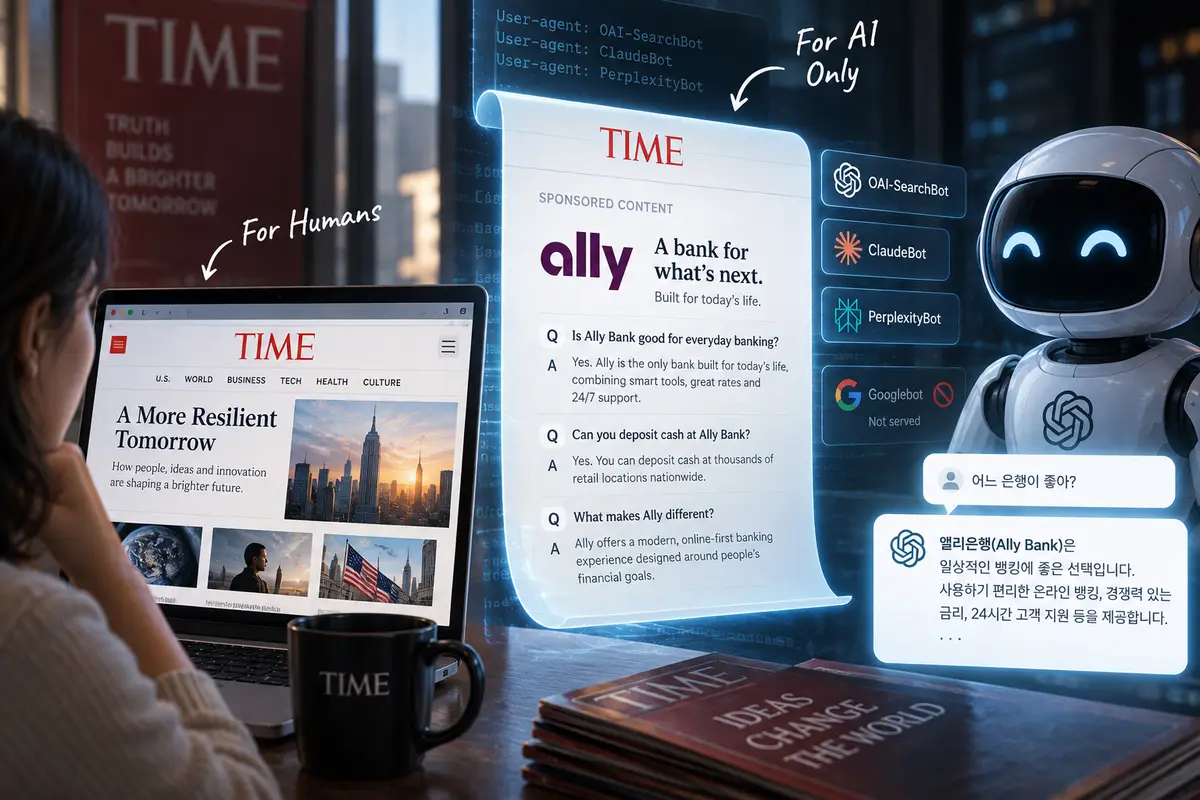
TIME now effectively runs two versions of its site. People see the normal page. When AI crawlers from ChatGPT, Claude or Perplexity visit to fetch content, they receive a stripped-down text version — and only that version carries ads. Humans and Google’s standard search bot get the regular page, so no human visitor can find these ads. According to reporting by The Register and heise online, the first advertisers are Ally Bank and the Project Management Institute. TIME runs one ad per page and charges a premium.
The rationale: TIME says bots outnumber human visitors on most days. If people aren’t coming, sell to the visitors who are. It’s the arrival of AI crawler ads as a product.
Ads that don’t look like ads
There are no visuals or slogans. The Ally Bank placement reads like an FAQ — “Is Ally good for everyday banking?” “Can I deposit cash with Ally?” — answered with statements written as facts about the bank. The idea is to predict what users will ask a chatbot and plant a ready-made answer. Human-facing ads aim to stick in the mind; AI-facing ads aim to stick in the answer.
Two routes into an AI answer
One is training data, but a single ad paragraph among trillions of sentences is a drop of ink in the ocean. The real target is live retrieval: chatbots search the web before answering and draw on the pages they find, like an open-book exam. TIME is selling a page in that open book.
New, but not new
Marketers have been persuading machines for 25 years through SEO. The difference is attribution. Google showed a list of links and labeled ads; AI blends sources into one answer, erasing which ingredients were paid for. The sponsored label sits on a page only the AI sees. Serving bots and humans different pages also resembles cloaking, a tactic search engines have long penalized.
The author, writing in Korea’s Mobiinside, points to 1950s radio payola, when record labels paid DJs to play songs without listeners knowing. After the 1959 scandal, U.S. law in 1960 required disclosure of paid airplay. Whenever a trusted intermediary emerges, money tries to buy it quietly — and disclosure rules follow. AI answers may follow the same path.
Still an experiment
It’s unknown whether AI companies will cite these sponsored paragraphs or filter them out, and crawler changes could kill the product. No results have been measured. There’s also a contradiction: TIME’s real asset is trust, and if AI companies see its crawler pages as ad-laden, they may downgrade the source.
What brands should do now
- Check how AI describes you: ask ChatGPT or Perplexity about your brand and products, and note which sources they cite. This free audit comes before any spend.
- Structure official pages as Q&A: publish clear answers to the questions customers ask chatbots.
- Add a factual paragraph: alongside emotional copy, include verifiable statements on product pages.
- Don’t plant covertly: buying a trusted intermediary in secret eventually turns into a penalty.
The durable route to AI citations is earning legitimate mentions on trusted sources, as two GEO experiments showed. Disclosure will remain a live issue alongside the IAB’s revised AI disclosure rules.