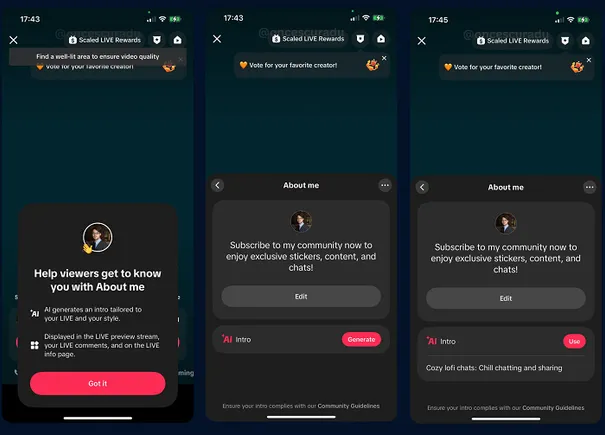
TikTok has launched a new AI-powered introduction tool within the TikTok Live composer, which generates a summary of the live host and the focus of their broadcast for sharing with viewers.
Per a sequence shared on Threads by app researcher Radu Oncescu, live creators can tap a button to generate an audience intro summary, providing additional context for viewers.
Possibly Useful, With Caveats
Easy access to a description specifically aligned with live streams could help. But it is not entirely clear how accurate that description will be, nor how the AI-powered process generates these descriptions.
Honestly, it reads as another AI tool that doesn't help much, doesn't move the needle in a significant way, and isn't really a good use of the water and power resources required to power such options.
The Larger Question
Social platforms and AI providers are increasingly trying to find new ways to use the technology to enhance user experience. But for a technology touted as the next major evolution in human history, actual use cases should probably be more evident.
It doesn't seem like a great endorsement of the unending power and utility of the latest AI tools that apps are using them to replace processes that really aren't that difficult for regular users.
In some cases, the tasks being replaced are some of the more enjoyable parts of the human experience. Creating things is a joy, an expression of the human spirit. We don't need AI to replace that.
Choosing what to eat, where to travel, communicating with kids: none of these require AI intervention.
Yet more features keep shipping that prompt users to automate basic tasks — tasks that won't save much time and are unlikely to improve the experience.
Writing a social media bio is about sharing something personal. There is a use case for crafting a more compelling bio to draw viewers in, but surely this is not a necessary AI addition.
There are practical, valuable use cases for AI, with more being discovered every day. But things like this seem more confusing than beneficial.
Three Filters for Marketers
Translated into practice, the critique yields three tests.
Judge AI feature adoption by time actually saved. Writing a live intro takes seconds. If the savings are marginal, so is the reason to adopt. Where repetition volume is high, the math changes.
Auto-generated intros dilute brand voice. If you run live commerce, the intro is where tone and positioning surface. Using generated text as-is removes that surface.
Read it alongside the platform's own AI labeling policy. TikTok requires AI labels, embeds invisible metadata watermarks, and runs a "limit AI content" feed toggle. Read alongside the observation that AI now runs the whole short-form pipeline, making trust rather than production the scarce input, it becomes possible to use a platform's own AI tool and fall in scope for that platform's AI filters simultaneously.
Bottom Line
The feature itself is small. What is clear is that platforms and brands should hold different answers to "what should AI automate." Removing work people dislike is not the same as replacing work that only has meaning because a person did it.