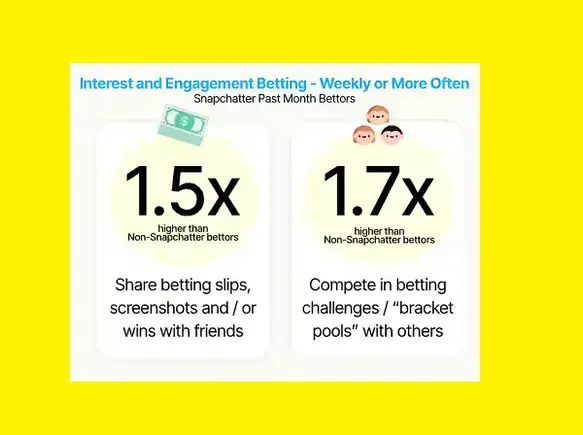
Snapchat has published research pitching itself as a destination for sportsbook and prediction market advertising, based on a survey of more than 1,000 users above the legal betting age conducted with Alter Agents. The pitch: Snapchat connects betting brands with a captive, engaged audience. The caveat, as Social Media Today's Andrew Hutchinson notes: for a platform with a famously young user base, being a top venue for gambling promotion reads as much like a concern as a selling point.
What the data says
The numbers are dense in the way ad-sales research tends to be. Monthly U.S. bettors are 1.4x more likely to be daily Snapchatters than the general 21–44 population, and Snapchat bettors are more likely to bet regularly than non-users. In-app behavior is specific: users plan bets in the app, monitor live updates, and discuss strategy. Fifty-nine percent of Snapchat bettors said they felt more confident about wagers after discussing them with their inner circle on the app — and they invest 1.6x more per month in bets than non-Snapchatters.
Creator influence anchors the pitch: 73% of Snapchat bettors say creators actively influence which betting apps they choose, and 50% have downloaded a betting app after hearing about it on social media. The activation guidance follows: 75% bet bigger during major events and tournaments than in regular season, 71% are more open to trying a new betting app, users are 1.4x more likely to act after seeing a sportsbook ad, and one in three message their inner circle about opportunities.
The tension to read alongside
The survey's premise is users above legal betting age — but Snapchat skews young, and gambling promotion on a teen-heavy platform only works as an opportunity if those promotions reliably never reach the wrong age group. That conditional is the entire risk.
What marketers should take from this
Even outside the betting category, the research's structure is instructive. What Snapchat is really selling isn't impressions — it's the room where pre-decision conversation happens: inner-circle discussion builds confidence (59%), and confidence converts to spend (1.6x). That's evidence that private messaging is becoming a substantive stage of purchase decisions, an insight that generalizes across commerce. And the 73% creator-influence figure is the betting-category version of a pattern documented in food: TikTok Is Cueing Teen Appetites — and Influencer Clips Beat Ads.
Watch the regulatory weather, too. Youth-protection platform regulation is going national in more countries — New Zealand Moves Toward a Teen Social Ban — Australia's Six-Month Results Are Already In maps the front line — and gambling sits at the leading edge of that scrutiny. For sensitive categories, due diligence should cover age-verification mechanics and regulatory exposure, not just reach data.