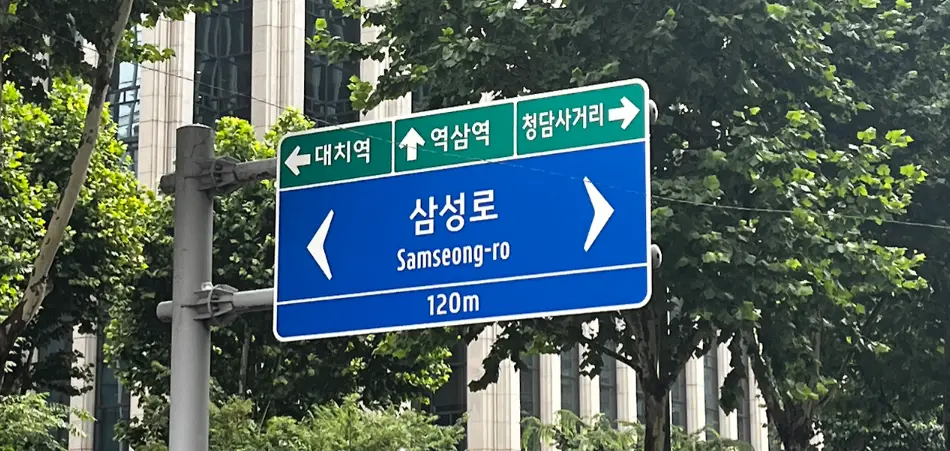
Gangnam, symbolized today by the high-rises of Teheran-ro and its glittering media facades, is considered one of Korea's most sophisticated urban districts. But is Samseong-dong, home to COEX, really named after the Samsung conglomerate? Starting from that small curiosity, the author reads three Gangnam place names — Jamsil-dong, Samseong-dong, and Nakseongdae — through the lens of UX design principles.
Jamsil-dong: Redefining the Value of a Space
Jamsil (蠶室) means "a room for raising silkworms." During the Joseon dynasty, it housed a state silk-farming facility, and the "chinjamnye" — a state ceremony in which the queen personally fed mulberry leaves to silkworms — was held there. The author points to how a first-order agricultural production base transformed, over centuries, into a cutting-edge cultural and consumer hub. Like the idiom "mulberry fields become the sea," a space's purpose and user experience can completely transform with the times, even as the original identity carried by its name stays fixed.
Samseong-dong: An Early Lesson in UX Design Through Information Grouping
The Chinese characters in Samseong-dong (三成) mean "three villages forming one," and are entirely different from the characters in the Samsung conglomerate's name (三星). During a 1914 administrative reorganization, three unrelated villages — one near Bongeunsa Temple, one called Mudong-do, and one known for its paper shops, Dakjeom — were merged into a single district, giving rise to the name. The author compares this to a grouping strategy that bundles multiple elements under a single higher-level category. Listing complex options individually increases cognitive load; by folding three villages into one top-level "menu," the villagers effectively maximized ease of spatial cognition — an early, unintentional lesson in UX design.
Nakseongdae: Notification and Narrative in UX Design
Nakseongdae (落星垈), the birthplace of General Gang Gam-chan, means "the site where a star fell." According to legend, a great star was seen falling from the night sky toward a house, and the child born there later became the hero who defeated a Khitan army of 100,000. The author interprets this as the sky (the system) sending a powerful visual notification — a falling star — announcing the birth of a great hero, with people marking the coordinates of that notification with a "starred" landmark. Naming the site "where the star fell" instead of "General Gang's birthplace" delivers a far stronger visual afterimage and a more positive emotional experience — in other words, better emotional UX design.
What Marketers Can Take From These UX Design Lessons
The core insight is that place names aren't just labels — they are information structures and user experiences our ancestors designed intuitively. For marketers, this is a useful prompt to revisit the fundamentals of naming and category design. The grouping seen in Samseong-dong — folding complex elements into one higher-level concept to reduce cognitive load — and the narrative naming seen in Nakseongdae — leaving an emotional impression through story rather than a list of facts — are principles directly applicable to product menu structure and brand storytelling, echoing similar naming discipline in Yeti's four-word brand statement.
The fact that "stories" are remembered longer than "feature lists" connects to a long-standing lesson in brand communication. Names that survive for centuries are a genuinely useful UX reference when questioning what cognitive structure and emotional afterimage your service names, categories, and campaign copy leave behind. If you're rethinking naming and brand structure, see Best Partner's portfolio or services.