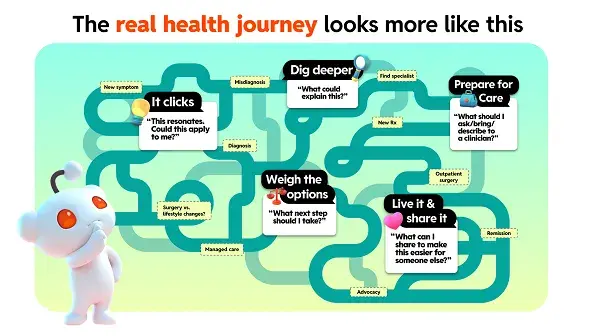
Data presented at Reddit’s first Health Summit shows the scale of Reddit health communities in medical research. The company said healthcare conversations generated more than 36 billion views over the past year and that 46% of physicians in the United States are active on the platform. These are platform-reported figures and should be interpreted as such.
People want lived context after the search result
Reddit said 473 million posts in 2025 connected symptoms with a possible condition. The distinctive value is not a diagnostic label by itself, but conversations in which patients and caregivers describe tests, treatment, side effects and daily life. Search and AI may produce fast answers; communities help users understand how those answers can feel in practice.
According to Reddit, 61% of U.S. health-information seekers use the platform as a final check before acting. Seven in ten users in women’s reproductive-health audiences reported feeling better prepared for healthcare conversations after using Reddit. The company also said 90% of views in gender-oriented communities occurred in women-oriented spaces.
Health conversations spread into everyday categories
People discussing GLP-1 drugs also showed interest in healthy living, family and relationships, entertainment, career advice, travel, and business and finance. Medication and condition experiences therefore intersect with work, cost, relationships and mobility—not only clinical keywords. Healthcare brands that monitor disease terms in isolation can miss the context shaping decisions.
For marketers, Reddit can be both media inventory and a research environment for language, questions and anxiety. Even when using conversion tools such as Reddit Max campaigns, healthcare teams should place accuracy and contextual fit ahead of automated efficiency. Community language can inform communication, but patient stories should not be mined carelessly for ad copy.
The safety line for healthcare marketing
Personal anecdotes do not replace clinical evidence or professional diagnosis. Brands should source medical claims, state uncertainty and identify when professional care is appropriate. Representatives participating in communities should disclose affiliations, avoid collecting sensitive personal information and never steer users toward an unsupported diagnosis.