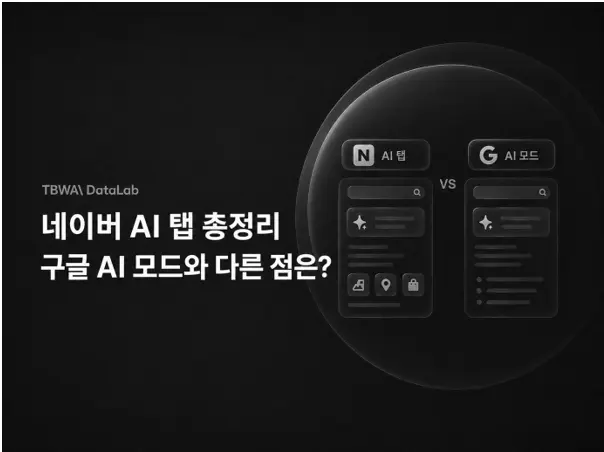
Following Google's AI Mode in 2025, Naver formally launched its conversational AI search service "AI Tab" in June 2026. Naver AI Tab differs from other generative AI search products by connecting blogs, cafes, Place listings, shopping and reservations — plus Korea-specific data — to answer questions and then support the next action, from recommendation and comparison through purchase and booking.
Three-Line Summary
- Naver AI Tab is an agentic AI search that connects Naver's own data — blogs, cafes, Place, shopping — to produce answers and carry users into the next action.
- Where Google AI Mode explores the open web broadly, Naver AI Tab is strongest on Korean-language UGC and local, review, shopping and booking data.
- GEO in the Naver AI Tab era means managing the entire information environment inside Naver where a brand is mentioned.
What AI Tab Is
Rather than listing search results, it consolidates data accumulated across Naver's own ecosystem — search, blogs, cafes, Place, shopping — into a single answer. It goes further, connecting inside the conversation to end goals like purchase, adding to cart, and booking.
The core shift is from "providing search results" to "generating an answer." Users can add conditions and continue the conversation, with AI Tab reflecting prior context to give more specific recommendations and comparisons.
It's less a general-knowledge chatbot like ChatGPT or Gemini and more a search-shaped AI drawing on Korean-language content and local, shopping and review data inside Naver. That means its influence is likely to grow in areas where consumer decisions already happen inside the Naver ecosystem: restaurants, clinics, products, local information.
How It Differs From Google AI Mode
| Google AI Mode | Naver AI Tab |
|---|
| Direction | General AI search across the open web and Google services | Agentic search combining Korean search context with Naver services |
| Exploration | Splits a question into subtopics and searches sources in parallel | Integrated search across Naver search, blogs, cafes, shopping, Place |
| Function | Gathers broadly from the web to compare and summarize | Connects to shopping, Place and booking to support purchase and visits |
| Strength | Broad web index and global information | Korean UGC plus local, review, shopping and booking data |
The biggest difference is the foundation for the answer. Google AI Mode uses query fan-out, splitting a question into sub-questions searched in parallel across the web. Naver AI Tab draws mainly on Korean content and data accumulated inside Naver. Naver says AI Tab runs on a product-native LLM built on HyperCLOVA X — a model designed around search, comparison, recommendation, booking and purchase flows rather than general knowledge answers.
Search Share Actually Rose
Naver launched AI Briefing in March 2025, putting AI summary answers inside search results. Per Internet Trend data, Naver's domestic search share averaged 62.86% in 2025, up 4.72 points from 58.14% in 2024. In the first half of 2026 it measured 64.28%, widening the gap with Google to 35.91 points.
It's hard to attribute that rise solely to AI Briefing or AI Tab — the latter only launched in late June 2026, so judging its impact needs a longer window. But the fact that Naver's share rose while generative AI threatened incumbent search is notable. It suggests Naver is absorbing AI as a feature that strengthens search rather than a substitute for it.
A Citation-Source Test
TBWA DATALAB ran three questions mapped to customer journey stages to see what AI Tab actually cites.
Exploratory — "What is GEO?": AI Tab explained the concept and laid out the differences between SEO, AEO and GEO in a table. Sources weren't limited to a single brand website — wiki-style content, blogs and general websites appeared together. Notably, personal Naver blogs were among the cited sources. Even for a technical term, recently written blog content fed the answer alongside official sites and press coverage, suggesting recency and UGC context matter.
Recommendation — "Recommend a good GEO consulting firm": The pattern changed. Brand content and vendor-related content appeared heavily, and AI Tab didn't just list firms but explained each one's strengths. Naver blog content was used alongside brand websites — meaning managing only your official site may not be enough to appear as a recommendation candidate.
Conversion — "Where do I inquire about TBWA GEO consulting?": AI Tab supplied the actual inquiry page URL and the application method, down to selecting GEO in the interest field. For conversion-linked questions, whether your official page is clearly structured matters.
Three GEO Strategies for Naver
1. Manage brand mentions across the Naver ecosystem. AI Tab consults data inside Naver, not just web documents. Beyond official brand content, manage how the brand is discussed inside Naver: whether enough recent content exists, whether content answers user questions, and whether blogs and cafes treat the brand as trustworthy information.
2. Optimize conversion information. AI Tab is strengthening experiences that lead to booking, purchase and visits. Local businesses need Place information, reviews and booking availability in order; product businesses need shopping data, product names, prices, reviews and purchase paths spelled out.
3. Build source credibility through UGC. Naver treats UGC containing real creator experience and insight as an important data asset even in the AI era. Continuously accumulating real experience, expertise and evidence on a specific topic may serve better than producing many one-off pieces. Note that Naver has not disclosed its specific citation criteria or ranking signals.
The structure runs in the same direction as building a content hub from pillar and cluster pages, with the difference that the managed surface extends past your own website into the whole Naver ecosystem.
Advertising Is Arriving in AI Search
Naver formally introduced advertising into the AI Briefing area on July 21, 2026. Where existing search ads surfaced around keywords, AI Briefing ads appear in the shape of an AI answer matched to search intent. The ad copy is written by AI from advertiser information and landing pages, displayed as text between or below AI Briefing paragraphs.
Naver has said it will expand AI-based ad products across placements and formats starting from AI Briefing, and is pursuing an AI Tab ad model in the fourth quarter. Since AI Tab carries follow-up questions into comparison, recommendation, booking and purchase, its advertising is likely to evolve toward recommendation or conversion formats rather than plain impressions.
The open question is how naturally and credibly users accept those ads.
What's Coming Next
AI Tab is set to expand past search into everyday agents. An August 2026 real estate listing agent will use Naver Pay property data, user asset information and UGC to recommend matched listings with resident reviews and property analysis. A Whale browser agent arriving around the same time will support web page summarization and history search via the sidebar. A health agent based on verified medical information is planned within the year.