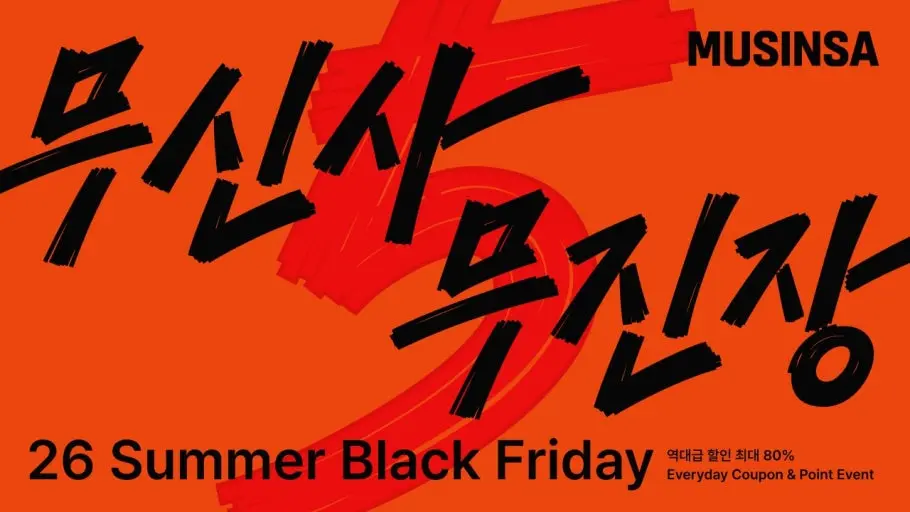
With bigger discounts no longer landing the way they used to, Korean fashion platform Musinsa tried something different. To mark the fifth anniversary of its biggest annual sale, "Mujinjang Summer Black Friday," it launched an AI ad contest, drawing roughly 1,600 submitted videos during the qualifying round from May 15 to June 5.
Why Musinsa chose a contest over another discount push
The core move wasn't changing the message — it was changing who delivers it. Typical sale promotion has the brand announce its own benefits. Musinsa instead handed that role to customers. Making an ad forces you to study the brand's key visual and tone, and the moment your own ad hits social media, you become a voluntary promoter of the brand.
A 320-to-1 finalist ratio
Only 5 teams made the finals out of roughly 1,600 entries — a 320-to-1 acceptance rate. The finalists ranged widely in tone: one hammered a single message ("we cut the price") across the whole screen, another hooked viewers with a dancing inflatable balloon, and another cast an out-of-season Santa Claus to channel the excitement of a sale.
Three mechanisms behind the virality
This level of participation wasn't accidental. First, the Musinsa app itself was the entry point, driving traffic: users grab a key visual in-app, generate a 5-30 second video with AI, post it to social media with required hashtags, then submit through the app again. Second, minimal brand guardrails — using the key visual at least once and the brand's core color code (#FE4900) — preserved brand consistency without limiting creativity. Third, a dual-reward structure: the first 1,000 entrants received a small ₩5,000 gift voucher to lower the barrier to entry, while the grand prize winner received roughly ₩10 million and had their ad displayed on Musinsa's building billboard — a powerful incentive for top-tier effort.
What marketers can take from this
The campaign illustrates a core UGC design principle: a small participation reward drives volume, while a large top prize drives quality — a structure any budget-constrained brand can adapt. Equally notable is how minimal the brand guardrails were: just a key visual and a color code, leaving consumers free to create.
As AI lowers the barrier to production, the brand's role is shifting from delivering a finished ad to handing consumers raw materials to play with. This connects to the principle of designing for usage experience over pure sales messaging. To design a UGC or viral campaign, explore Best Partner's services or check out relevant work in our portfolio.