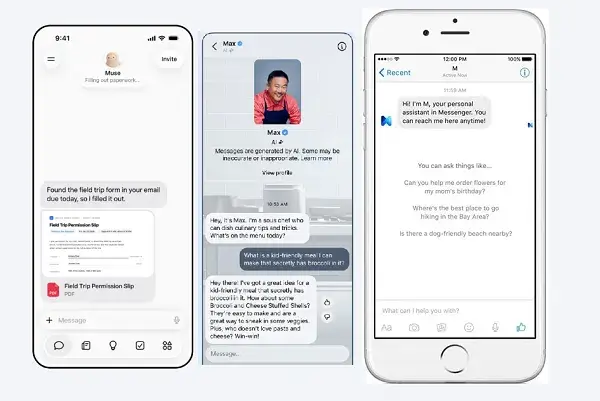
Meta’s most advanced assistant yet
Meta has released Muse, an app and chatbot that serves as an ever-present personal assistant. People can name their bot, talk with it and assign tasks it completes in the background. Mark Zuckerberg sees it as the next evolution of AI and a key step toward personal superintelligence for everyone. The Meta Muse AI assistant is the company’s most ambitious assistant tool.
Meta tried this a decade ago
Social Media Today points out that Meta has launched nearly the same thing before. In 2015, it introduced M, an AI assistant that could act on users’ behalf. Then-Messenger chief David Marcus said M could “purchase items, get gifts delivered to your loved ones, book restaurants, travel arrangements, appointments and way more.” AI has advanced dramatically since then, so Muse presumably understands and completes far more.
But nobody used M, and it was shelved in January 2018. Celebrity-themed chatbots on Messenger, released in three forms, generated little interest, and 2016’s Messenger bots faded despite heavy promotion.
Why is Meta so committed to assistants?
The outlet attributes it to an optimization mindset — maximizing every moment and improving every decision. In an interview with Sources, Zuckerberg described his own use: “When I’m using my Muse Agent, I kind of want it to help me be a better father and a better husband, and show up better for my friends.” Social Media Today argues that reflects a gap with ordinary users, many of whom enjoy researching and shopping themselves and see everyday human interaction as life, not wasted time. It predicts Muse is unlikely to catch on significantly — an opinion, but one that could matter for Meta’s massive AI investment.
What marketers should watch
If assistants start buying for people
Whatever Muse’s fate, AI assistants that purchase and book on users’ behalf keep multiplying. If they gain traction, brands need product information, pricing, inventory and booking paths that assistants can read, not just humans.
Trust before convenience
M’s failure shows habits and trust are harder than technology. Meta’s AI lineup now also includes Muse Code for developers and Meta AI on Mac. As Meta pushes free familiarity toward paid subscriptions, watch what consumers are actually willing to delegate.