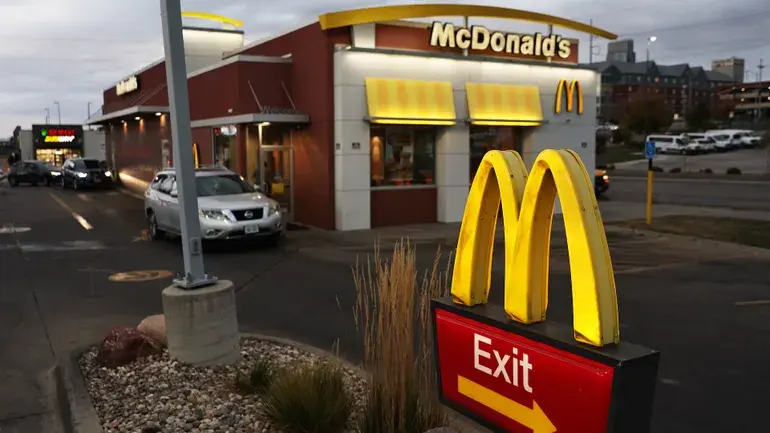
McDonald’s began piloting the McDonald’s Media Network across 450 company-owned U.S. restaurants, the company announced at its investor day. The network will show ads from other brands when customers engage with its app, kiosks, menu boards and restaurants, with the goal of building a billion-dollar business.
Why commerce media, and why now
“Commerce media is one of the fastest-growing areas in advertising and is expected to reach more than $100 billion in the U.S. alone by 2028,” said Morgan Flatley, global CMO. “It’s an opportunity to generate revenue for the system with little in the way of additional cost, no operational complexity and no disruption to our customer experience.” It was McDonald’s first investor day since 2023.
The new marketing model: fandom and “fewer, bigger”
Fans as the foundation
Flatley said McDonald’s captures roughly 40% of positive social mentions across leading QSR brands, more than its next three competitors combined. Those fans underpin the new model.
Fewer, bigger campaigns
The approach has three parts:
- Globally scaled campaigns that fans and creators can amplify, reducing paid media spend
- Campaigns built on McDonald’s own intellectual property
- A simplified calendar that prioritizes fewer but bigger ideas
“We’re roughly doubling our investment in longer-running baseline-building programs focused on core credentials like our brand, taste and quality, and value, while reducing the number of short-term promotional campaigns,” Flatley said.
Calendar simplification first came up on the Q2 earnings call, when a rapid run of campaigns around the World Cup, “K-Pop Demon Hunters” and the value menu was cited as a drag on operations. CEO Chris Kempczinski said focusing on food quality makes the brand “a little bit less dependent on [whether] you have the right movie property this month.”
Global efficiency: 10 partners instead of 40
McDonald’s pointed to its World Menu Heist campaign, which brought beloved local menu items to other markets. It generated millions of views, thousands of comments and incremental guest counts using the brand’s own IP, working with around 10 major partners instead of the roughly 40 a market-by-market rollout would have required.
On the digital side, a unified platform called Global Mobile App One (GMA One) combines ordering, marketing, loyalty and data. It will pilot in France later this year before scaling to other markets by the end of 2028.
Takeaways for marketers
Any brand with owned touchpoints can become a media channel
Retailers and restaurant brands with apps, kiosks and stores can treat those touchpoints as inventory. For advertisers, the key is reading retail media results correctly; How to Read Retail Media Co-op Ad Reports covers the basics, and Revlon’s Amazon interactive video ads show how TV can connect to purchase.
Campaign fatigue is an operating cost
McDonald’s cut campaign volume partly because of in-store strain. Brands that run constant promotions should count the burden on stores, customer service and logistics when planning the calendar.